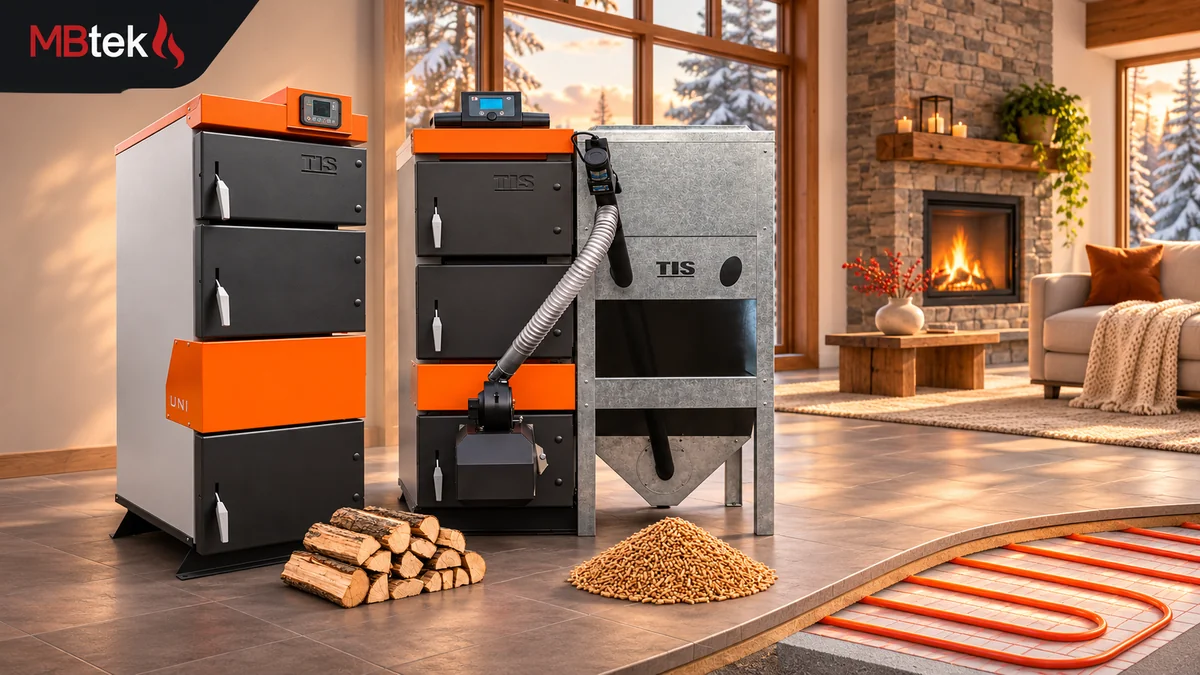
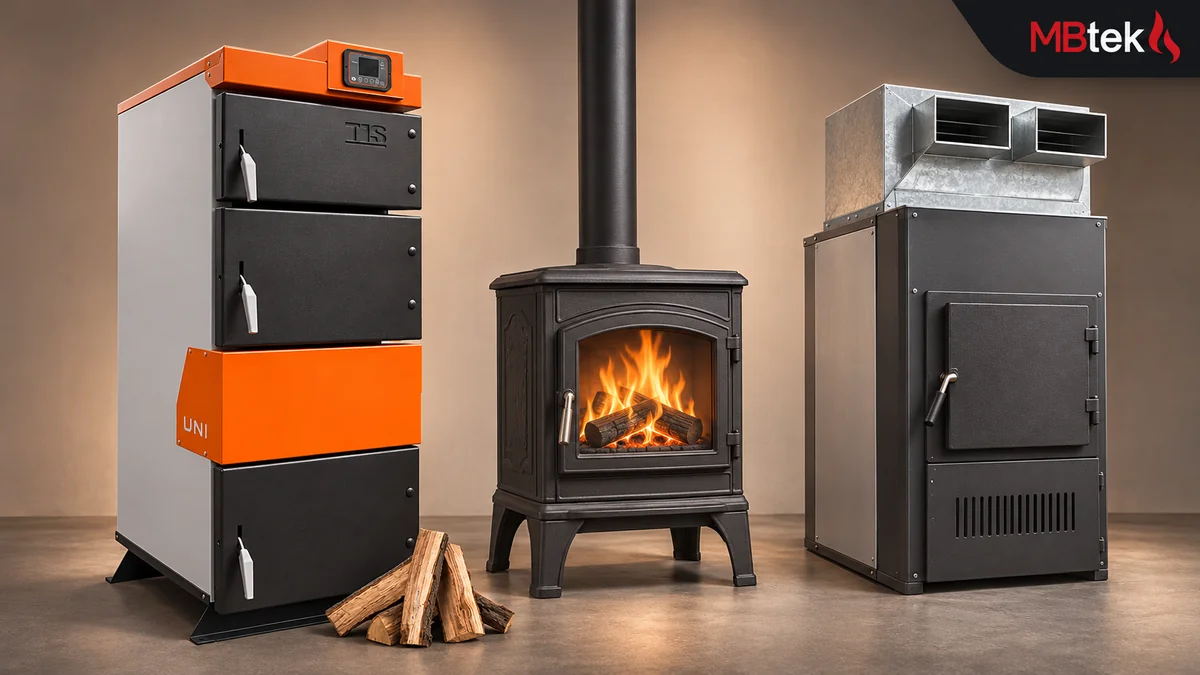
A wood stove heats the space around it, a wood furnace distributes warm air through ducts, and a wood boiler heats water that can carry warmth throughout a building.
All three burn wood, but they solve different heating problems.
A stove might be perfect for making a living room feel cozy. A furnace can make sense in a home with ductwork. And a boiler can be a strong option when you want to heat radiant floors, radiators, or several areas from one central system.
The best choice starts with a simple question: Where do you want the heat to go?
Wood Boiler vs Wood Stove vs Wood Furnace: At a Glance
| Wood stove | Wood furnace | Wood boiler | |
|---|---|---|---|
| What it heats first | The surrounding room | Air | Water |
| How heat travels | Radiates and circulates through nearby spaces | Blower and ductwork | Pipes to hydronic heating equipment |
| Typical use | Room or supplemental heating | Central heating with ductwork | Central heating with water-based distribution |
| Radiant floors or radiators | Not directly | Not directly | Possible with a properly designed system |
| Domestic hot water | Not usually its main job | Not usually its main job | Possible with compatible equipment and controls |
| What to plan for | Placement, chimney, clearances, and heat reaching other rooms | Compatible ducts, blower, controls, and chimney | Piping, controls, boiler protection, chimney, and potentially thermal storage |
- What it heats first
- Wood stove
- The surrounding room
- Wood furnace
- Air
- Wood boiler
- Water
- How heat travels
- Wood stove
- Radiates and circulates through nearby spaces
- Wood furnace
- Blower and ductwork
- Wood boiler
- Pipes to hydronic heating equipment
- Typical use
- Wood stove
- Room or supplemental heating
- Wood furnace
- Central heating with ductwork
- Wood boiler
- Central heating with water-based distribution
- Radiant floors or radiators
- Wood stove
- Not directly
- Wood furnace
- Not directly
- Wood boiler
- Possible with a properly designed system
- Domestic hot water
- Wood stove
- Not usually its main job
- Wood furnace
- Not usually its main job
- Wood boiler
- Possible with compatible equipment and controls
- What to plan for
- Wood stove
- Placement, chimney, clearances, and heat reaching other rooms
- Wood furnace
- Compatible ducts, blower, controls, and chimney
- Wood boiler
- Piping, controls, boiler protection, chimney, and potentially thermal storage
One naming detail can cause confusion: “outdoor wood furnace” is sometimes used to describe a water-heating appliance that is really a hydronic heater or wood boiler. Ask whether the equipment heats air or water before comparing it. The U.S. EPA describes the distinction.
What Is a Wood Stove?
A wood stove is a freestanding appliance that burns wood and releases heat into the space around it.
It is the option many people picture first: a fire visible through the door, a warm living room, and a stack of firewood nearby.
A stove can be a good fit if you want to:
- Heat a main living area or cabin
- Add supplemental heat to an existing system
- Enjoy a visible fire
- Keep the heating setup focused on one part of the home
The limitation is distribution. The room with the stove can become very warm while a bedroom down the hall stays cooler. An open floor plan may help heat move through the home, but a stove does not distribute heat through every room in the same way as a central ducted or hydronic system.
Good fit: You mainly want warmth where the stove is located.
Think twice if: You need predictable heat across several closed rooms or want one system to serve multiple heating zones.
What Is a Wood Furnace?
A wood furnace burns wood to heat air. A blower then moves that warm air through ductwork and delivers it to rooms through vents.
If your home already has a forced-air system, a wood furnace may be an option to investigate. Some installations are designed to work alongside another furnace, but the equipment and ductwork must be compatible and properly planned.
A wood furnace can be a good fit if you want:
- Wood-fired central heating through ducts
- Warm air delivered to several rooms
- A system that works with a forced-air heating layout
The main difference from a boiler is what carries the heat. A furnace distributes warm air; a boiler distributes heated water. A wood furnace also generally depends on a blower, so electricity and power-outage planning matter.
Good fit: You have suitable ductwork and want central forced-air heating.
Think twice if: Your home relies on radiant floors or hot-water radiators rather than ducts.
What Is a Wood Boiler?
A wood boiler burns wood and transfers heat into water. That heated water circulates through a hydronic system—a heating system that uses water to move heat around the building.
Depending on the design, a wood boiler can supply:
- Radiant floor heating
- Hot-water radiators or hydronic baseboards
- Fan coils or a compatible air handler
- A thermal storage tank
- A domestic hot water tank
- Multiple heating zones or, in some projects, more than one building
The advantage is flexibility in where the heat goes. Instead of warming only the room around the fire, a properly designed boiler system can deliver heat through pipes to the areas that need it.
That flexibility also means more components to plan. The boiler is the heat source; a complete system may include circulators, controls, protection valves, a storage tank, and heat emitters.
MBTEK’s wood boiler collection includes indoor models intended for hydronic heating. The right model depends on the building and the full system design.
Which One Heats the Whole House Best?
There is no universal winner. The answer depends on how the house is laid out and how heat can be distributed.
Choose a stove for heat close to the fire
A wood stove can work well for an open living area, a cabin, or supplemental heat. It may also contribute heat to a larger home, but temperatures can vary from room to room.
Choose a furnace for ducted heat
A wood furnace is designed to move heated air through a duct system. If your home already has suitable ductwork, that may be a practical direction to investigate.
Choose a boiler for water-based distribution
A wood boiler is worth considering if your home has—or will have—radiant floors, hot-water radiators, fan coils, or other hydronic equipment.
It can also be useful when you want to plan for several zones, a workshop, or domestic hot water. Each additional load must be included in the design; it should not be assumed that any boiler can serve every building or application.
Can a Wood Boiler Work With a Forced-Air Home?
Potentially, yes. A wood boiler does not have to be limited to radiant floors and radiators.
A compatible hot-water coil in an air handler can transfer heat from the boiler’s water to air that is then distributed through ducts. This requires a properly designed coil, air handler, piping, controls, and safety arrangement.
In other words, a home may use water to carry heat from the boiler and air to distribute it to rooms.
That can be useful if you like the idea of hydronic heating but already have ductwork. It does not mean a wood boiler connects directly to every existing furnace without an assessment.
Which System Requires the Most Work?
All three require fuel handling and maintenance, but the work looks different.
| What to expect | |
|---|---|
| Loading wood | Stoves, furnaces, and many wood boilers need the homeowner to load fuel. Frequency depends on the equipment, weather, building, and operation. |
| Ash and cleaning | Expect regular ash removal and cleaning as required by the manufacturer. |
| Chimney and venting | Every installation needs appropriate venting and inspection for the appliance and local requirements. |
| Distribution equipment | Furnaces add duct and blower considerations; boilers add pumps, water circuits, controls, and other hydronic components. |
| Storage space | All wood-burning systems need a practical place to keep and handle suitable firewood. |
- Loading wood
- What to expect
- Stoves, furnaces, and many wood boilers need the homeowner to load fuel. Frequency depends on the equipment, weather, building, and operation.
- Ash and cleaning
- What to expect
- Expect regular ash removal and cleaning as required by the manufacturer.
- Chimney and venting
- What to expect
- Every installation needs appropriate venting and inspection for the appliance and local requirements.
- Distribution equipment
- What to expect
- Furnaces add duct and blower considerations; boilers add pumps, water circuits, controls, and other hydronic components.
- Storage space
- What to expect
- All wood-burning systems need a practical place to keep and handle suitable firewood.
A boiler system can include thermal storage, which holds heated water for later use. That can give the system more flexibility between when the wood burns and when the building needs heat. The benefit and sizing depend on the boiler and project.
For a closer look, read Why Your Wood Boiler Needs a Buffer Tank.
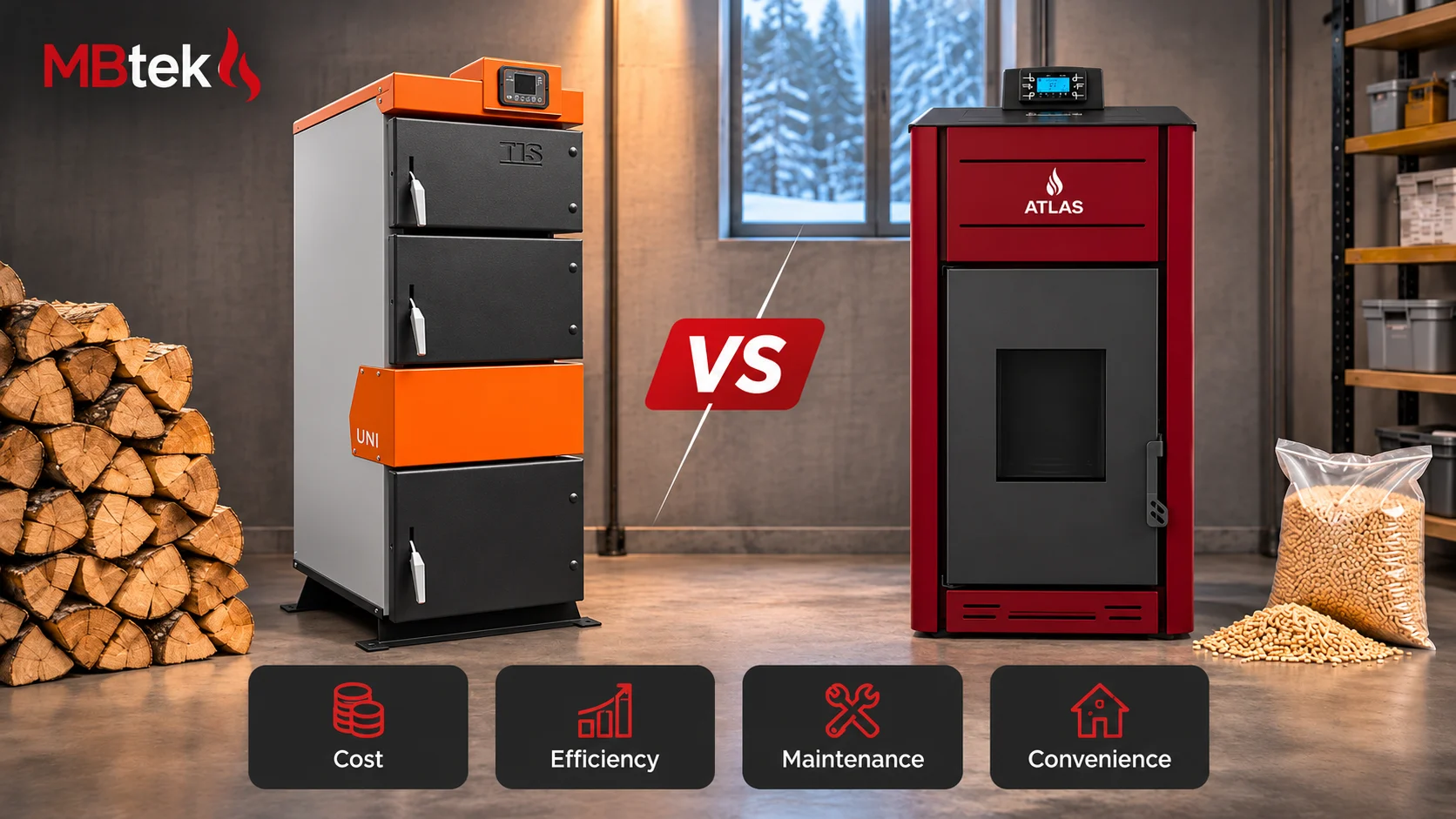
What About Cost and Efficiency?
The appliance is only part of the project.
A stove may be a straightforward choice for heating one space, while a central furnace or boiler system can require additional distribution equipment and installation work. Costs vary with the building, existing ducts or piping, chimney, storage needs, labor, and local conditions.
Efficiency is also more complicated than choosing a category. It depends on the specific appliance, fuel, installation, operation, and—in a central system—how effectively heat reaches the rooms.
A wood boiler may offer useful flexibility, but it is not automatically the cheapest or most efficient choice for every home. Compare complete systems that meet your actual heating needs.
What Should You Check Before Choosing?
Before deciding between a wood boiler, stove, or furnace, consider:
- What do you want to heat? One room, the whole home, a workshop, or several zones?
- What distribution system do you have? Ductwork, hot-water radiators, radiant floors, or none?
- How much heat does the building need? A heat-loss calculation is more useful than square footage alone.
- Where will the equipment go? Plan for access, clearances, venting, combustion air, and fuel storage.
- What happens during a power outage? Even if a particular boiler can operate without electricity, pumps or controls elsewhere in the system may still need power.
- How much hands-on work suits your routine? Consider loading wood, cleaning, and maintenance.
- What rules apply where you live? Check the appliance, installation, and local requirements with a qualified professional.
A qualified installer can help evaluate the complete system and its safety requirements before you purchase equipment.
Wood Boiler, Stove, or Furnace: Which Is Right for You?
Choose based on how you want to deliver heat:
- A wood stove makes sense when warmth near the fire is the priority.
- A wood furnace is worth considering when you want to distribute warm air through suitable ducts.
- A wood boiler is worth considering when you want water-based heat for radiant floors, radiators, fan coils, or multiple loads.
If you’re planning a new system or replacing existing equipment, start with the building’s heat loss and distribution system. Those details will narrow the options far more effectively than choosing by appliance name alone.