
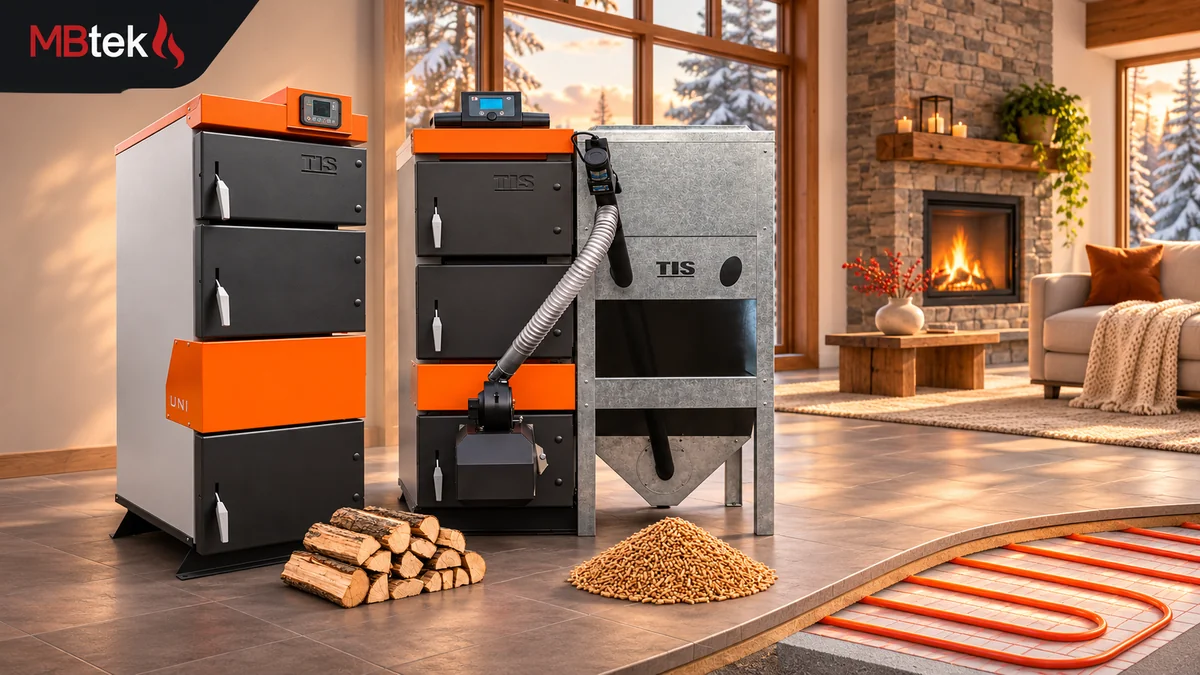
A wood boiler can heat a home’s radiant floors by sending heated water through tubing installed in or beneath the floor. The floor then releases that heat gradually into the room.
It sounds simple—and the idea is. But a good system needs more than a boiler and a set of pipes.
Wood boilers can produce a substantial amount of heat during a burn, while radiant floors usually need a steady supply of warm water at a lower temperature. Thermal storage and temperature controls help bring those two needs together.
Here’s how the components work, what makes a good match, and what to consider before planning your system.
How Does a Wood Boiler Heat a Radiant Floor?
A radiant floor heating system circulates warm water through loops of tubing installed in or under the floor. The floor absorbs that heat and releases it into the living space.
The wood boiler supplies the heat for that water. In a system with thermal storage, the general path looks like this:
Wood boiler → thermal storage tank → temperature mixing → radiant floor loops
Each part has a different job:
- The wood boiler heats water during the burn.
- The storage tank holds usable heat until the building needs it.
- A mixing device adjusts the supply temperature for the radiant floor.
- A circulator moves the water through a manifold and the floor loops.
- Cooler return water comes back to the heating system to be reheated.
This is a simplified overview, not an installation diagram. Actual piping, separation, controls, and safety devices depend on the equipment and the building.
Why Are Wood Boilers and Radiant Floors a Good Match?
The attraction is easy to understand: wood provides the heat, and the floor distributes it gently throughout the room.
Instead of relying on a few hot spots, radiant floor tubing spreads heat across a large surface. Many homeowners appreciate the comfort of a warm floor and the absence of air blowing from heating vents.
Radiant floors can also work at relatively low water temperatures compared with some traditional radiator or baseboard systems. That makes temperature control especially important when the heat source is a wood boiler.
The combination is not entirely hands-off. A wood boiler still needs fuel, loading, ash removal, and maintenance. And because floor construction holds heat, a radiant system may respond more slowly to thermostat changes than a forced-air system.
The best fit is a homeowner who values wood heat and is comfortable with the work that comes with it.
Why Add Thermal Storage to a Wood Boiler System?
A wood fire and a home’s heating demand do not always follow the same schedule.
Imagine loading your boiler on a cold morning. The fire produces heat, but the house may not need all of that heat immediately. Later, when the fire has burned down, the floor may still need warmth.
A thermal storage tank helps bridge that gap. It stores heated water while the boiler is producing heat, then allows the heating system to draw from that stored energy as needed.
Potential benefits include:
- More flexible heat delivery: The floor can continue drawing usable heat after the fire has burned down.
- Less need to match every burn to an immediate demand: Excess useful heat can be stored instead of being needed by the house at that exact moment.
- Better integration with zones and other heat sources: Storage can act as a central heat reservoir in a properly designed system.
How long stored heat lasts depends on the tank, its usable temperature range, the home’s heat loss, outdoor conditions, and other loads. It should not be treated as a guaranteed number of hours between firings.
Does every wood boiler require a storage tank? Requirements vary by boiler and system. Some systems may operate without one, while a manufacturer may require or strongly recommend storage for a particular model. Check the exact boiler’s instructions and the complete system design.
For more detail, see Why Your Wood Boiler Needs a Buffer Tank.
Why Does a Radiant Floor Need a Mixing Valve?
The water leaving a wood boiler or storage tank may be hotter than the radiant floor should receive.
A mixing device blends hotter supply water with cooler return water to provide a suitable temperature for the floor circuit. This helps the system deliver the heat the room needs while respecting the limits of the tubing, floor assembly, and flooring material.
The correct temperature is not the same for every project. It depends on the building’s heat loss, tube layout, floor construction, finish material, and system design.
Floor mixing and boiler protection are different jobs
This distinction is easy to miss:
- Radiant floor mixing controls the water temperature sent to the floor.
- Boiler return-temperature protection helps prevent excessively cool water from returning directly to the boiler under unsuitable conditions.
Cold return water can contribute to condensation and corrosion in a wood boiler. A boiler protection valve or loading arrangement may be specified to help maintain the conditions required by the boiler manufacturer.
Do not assume one mixing valve automatically performs both jobs. The installer should design and verify each function for the selected equipment. MBTEK lists a boiler protection valve and boiler station as accessories to consider; suitability depends on the project and boiler.
What Equipment Is Needed Besides the Boiler?
A complete system is made up of several components working together:
| What it does | |
|---|---|
| Wood boiler | Burns wood and transfers heat into the heating water. |
| Thermal storage tank | Stores heat for later use when included in the design. |
| Boiler protection arrangement | Helps maintain suitable boiler return conditions according to manufacturer requirements. |
| Mixing device | Controls the water temperature supplied to the radiant floor. |
| Circulators | Move water through the appropriate parts of the system. |
| Radiant manifold and loops | Distribute water to the floor circuits. |
| Thermostats and controls | Coordinate calls for heat, pumps, zones, and any backup heat source. |
| Safety and expansion components | Help manage pressure, temperature, air, and other operating conditions. |
- Wood boiler
- What it does
- Burns wood and transfers heat into the heating water.
- Thermal storage tank
- What it does
- Stores heat for later use when included in the design.
- Boiler protection arrangement
- What it does
- Helps maintain suitable boiler return conditions according to manufacturer requirements.
- Mixing device
- What it does
- Controls the water temperature supplied to the radiant floor.
- Circulators
- What it does
- Move water through the appropriate parts of the system.
- Radiant manifold and loops
- What it does
- Distribute water to the floor circuits.
- Thermostats and controls
- What it does
- Coordinate calls for heat, pumps, zones, and any backup heat source.
- Safety and expansion components
- What it does
- Help manage pressure, temperature, air, and other operating conditions.
Some projects also need a heat exchanger to separate circuits—for example, where the boiler and distribution system cannot operate as one compatible circuit. The need depends on pressure, equipment requirements, materials, and the existing installation.
The component list is a starting point, not a shopping list. The right arrangement must be designed around the selected boiler and the whole heating system.
Can a Wood Boiler Heat Radiant Floors and Domestic Hot Water?
Yes, a system can be designed to provide both space heating and domestic hot water.
For example, a compatible indirect water heater can use heat from the boiler system to warm household water for showers and faucets. The heating-system water and drinking water need appropriate separation through the designed heat-exchange equipment.
The important question is whether the boiler, storage, tank, and controls can meet both loads when needed. If the wood boiler is not fired during warmer months, you may also want another way to make domestic hot water.
That decision should be made early, because it affects equipment selection and the way the system is controlled.
Can You Add a Wood Boiler to Existing Radiant Floors?
Often, yes. If your home already has water-based radiant floor heating, a wood boiler may be able to serve it as a new or additional heat source.
Before deciding, have the existing system assessed:
- Is the floor system hydronic? Electric floor-warming mats are a different system and cannot be supplied directly by a wood boiler.
- What water temperature does the floor need? The answer affects the mixing and control design.
- What is the building’s heat loss? This helps determine the appropriate boiler and storage capacity.
- What equipment is already installed? An existing gas, oil, or electric boiler may be retained as backup in a suitable design.
- Are the circuits compatible? Pressure, materials, tubing, and any need for heat-exchanger separation should be checked.
- Where will the boiler and storage go? Access for installation, fuel handling, maintenance, venting, and clearances all matter.
Don’t choose a boiler based on square footage alone. Insulation, climate, ceiling heights, air leakage, domestic hot water, and other loads can change the amount of heat a building needs.
What Happens If the Power Goes Out?
This deserves attention during planning.
Some wood boiler models need electricity for fans or controls. Even if a particular boiler can operate without electricity, the circulators and controls in the wider heating system may still need power.
A qualified installer should plan for loss of power and overheating using the specific boiler manufacturer’s instructions and applicable local codes. Do not assume that a storage tank alone provides all necessary overheating protection.
The boiler’s location, chimney, combustion air, pressure and temperature protection, and maintenance access also need to be part of the design.
Is a Wood Boiler With Radiant Floor Heating Right for You?
A wood boiler and radiant floor system may be worth considering if you:
- Want to heat with wood and are comfortable loading and maintaining a boiler.
- Have—or are planning—a hydronic radiant floor system.
- Have suitable space for the boiler, fuel, and any thermal storage.
- Want to explore using one heating system for floors and potentially domestic hot water.
- Are prepared to have the complete system professionally designed and installed.
It may be less convenient if you want fully automatic heating, have limited space for wood and equipment, or are unable to tend the boiler regularly. A backup heat source can be considered as part of the design.
The key is matching the whole system—not just the boiler—to your home and routine. Boiler sizing, thermal storage, floor-water temperature, protection, and controls all affect how well it works.


