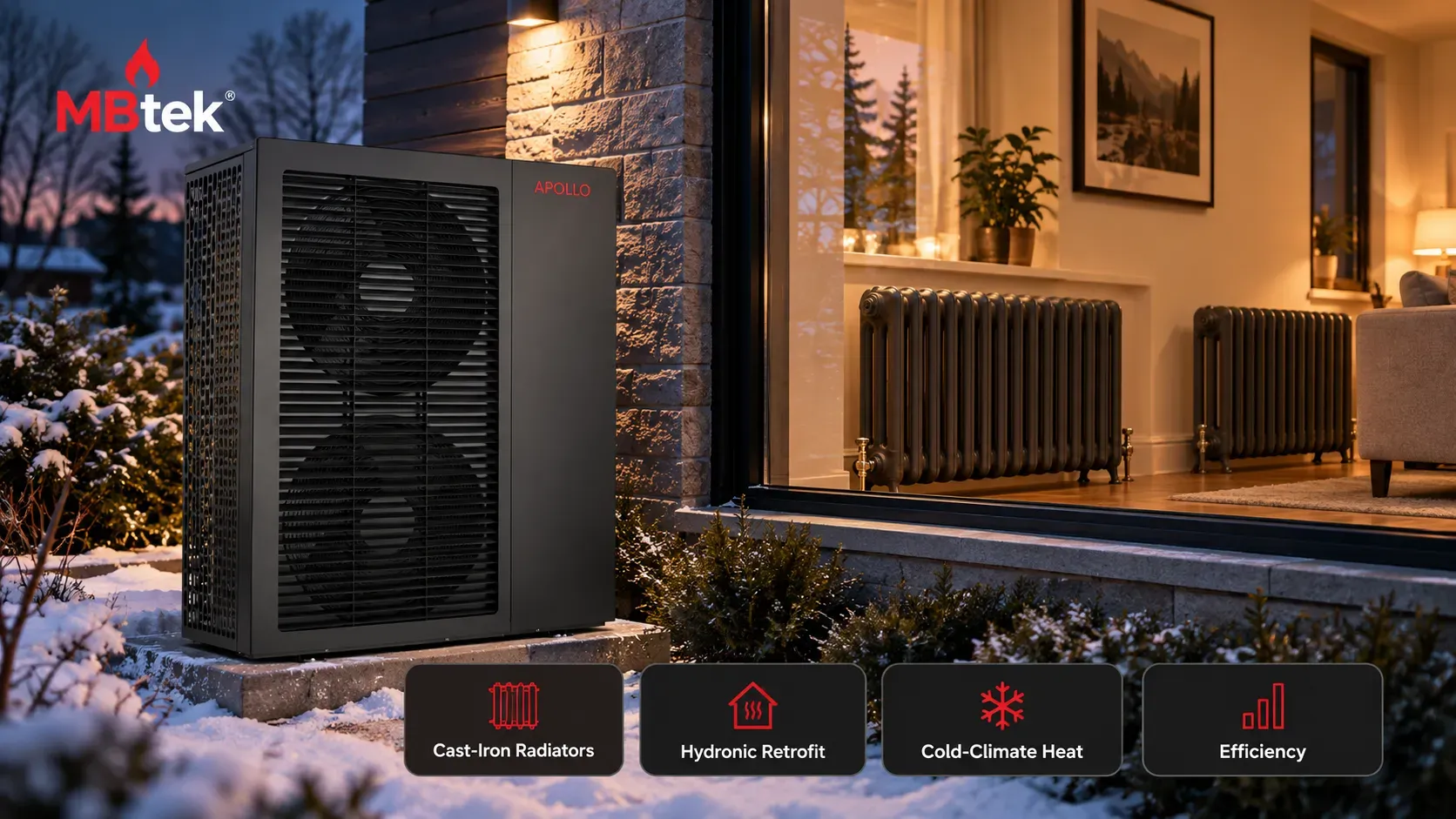
Yes, you can use a heat pump with cast-iron radiators, and in some older homes the combination can work surprisingly well.
The key question is not whether a heat pump can physically supply a radiator. An air-to-water heat pump produces hot water just like a hydronic boiler does, so it can feed a water-based radiator system.
The real question is whether your existing radiators can deliver enough heat at the water temperatures the heat pump can produce efficiently.
Older boiler systems were often designed around very hot water. Heat pumps generally operate more efficiently at lower water temperatures. Fortunately, large cast-iron radiators have significant surface area, and many were originally oversized for homes that have since received better insulation, windows and air sealing.
That can make an old cast-iron radiator system a surprisingly good candidate for a modern heat pump retrofit.
Can an Air-to-Water Heat Pump Run Radiators?
Yes.
An air-to-water heat pump extracts heat from outdoor air and transfers that energy into water circulating through the building.
That water can supply several types of hydronic emitters:
- Cast-iron radiators
- Panel radiators
- Hydronic baseboards
- Radiant floors
- Fan coil units
- Air handlers
From a plumbing perspective, this makes an air-to-water heat pump much closer to a boiler than a conventional ductless mini-split.
Instead of replacing every radiator with an indoor refrigerant unit, the heat pump can potentially become the new heat source for the existing hydronic distribution system.
The challenge is matching the heat pump's available water temperature to the heat output the radiators need.
Why Water Temperature Matters With Heat Pumps and Radiators
Traditional boilers can easily supply very hot water.
Many older radiator systems were therefore designed around water temperatures approaching 180°F or higher.
A heat pump operates differently.
The larger the temperature difference between the outdoor heat source and the water it has to produce, the harder the compressor has to work. In general, lower supply-water temperatures allow an air-to-water heat pump to operate at a higher COP and use less electricity.
Caleffi recommends designing modern hydronic heat-pump distribution systems around water temperatures of roughly 120°F or lower when possible because lower temperatures improve heat-pump performance. (Caleffi S.p.a.)
But that does not mean a radiator previously supplied with 180°F water cannot work at 120°F.
It simply produces less heat.
Cast-Iron Radiators Can Work at Lower Temperatures
A common misconception is that cast-iron radiators require extremely hot water to produce heat.
They do not.
They continue releasing heat whenever their surface temperature is above the surrounding room temperature. The amount of heat simply decreases as the water gets cooler.
Caleffi provides a calculation specifically for estimating the output of existing cast-iron radiators at different temperatures.
For example, one 10-section cast-iron radiator evaluated by Caleffi produces approximately 1,850 BTU/h with an average water temperature of only 115°F in a 70°F room. (Caleffi S.p.a.)
So the question should not be:
“Were these radiators originally designed for 180°F water?”
Instead, ask:
“How much heat do they produce at the lowest water temperature that will still satisfy the room's current heating load?”
That distinction can completely change whether a heat-pump retrofit is practical.
Why Old Cast-Iron Radiators May Actually Be an Advantage
Large radiators can be useful when converting an older home to a heat pump.
Consider a house built decades ago.
Its heating system may originally have been sized when the building had:
- Little wall insulation
- Single-pane windows
- Significant air leakage
- Poor attic insulation
- Higher overall heat loss
The radiators needed to be large enough to heat that original building.
Now imagine the same house after new windows, attic insulation, wall insulation and air sealing.
Its heating requirement may be substantially lower, but the original oversized radiators are still there.
Caleffi specifically notes that cast-iron radiators originally sized for poorly insulated buildings may need to provide only a fraction of their original output after the building envelope has been improved. That can allow them to operate at much lower water temperatures compatible with an air-to-water heat pump. (Caleffi S.p.a.)
In other words, oversized old radiators can become an asset rather than a problem.
Heat Pump With Cast-Iron Radiators: What Determines Whether It Will Work?
Four factors matter most.
| Why It Matters | |
|---|---|
| Building heat loss | Determines how many BTU/h the house actually requires |
| Radiator size | Larger surface area provides more heat at lower water temperatures |
| Required water temperature | Lower temperatures generally improve heat-pump efficiency |
| Winter climate | Heat-pump output and efficiency change as outdoor temperatures fall |
- Building heat loss
- Why It Matters
- Determines how many BTU/h the house actually requires
- Radiator size
- Why It Matters
- Larger surface area provides more heat at lower water temperatures
- Required water temperature
- Why It Matters
- Lower temperatures generally improve heat-pump efficiency
- Winter climate
- Why It Matters
- Heat-pump output and efficiency change as outdoor temperatures fall
The retrofit should therefore begin with a heat-loss calculation, not with the BTU rating of the existing boiler.
An old 120,000 BTU boiler does not mean the home currently needs 120,000 BTU/h.
Older boilers were frequently oversized, and improvements made to the building over the years may have reduced the heating load further.
How Do You Know What Temperature Your Radiators Really Need?
One of the most useful tests can sometimes be performed before removing the existing boiler.
During cold weather, reduce the boiler's supply-water temperature and see whether the home still maintains its target indoor temperature.
For example, a system that normally runs at 180°F might be tested progressively at:
- 160°F
- 150°F
- 140°F
- 130°F
- 120°F
This is only a practical observation—not a replacement for proper system calculations—but it can reveal how much excess radiator capacity exists.
A professional assessment is better.
The contractor can determine the surface area and output of each radiator, calculate room-by-room heat loss, and estimate the required water temperature under design winter conditions. Caleffi publishes formulas specifically for calculating cast-iron radiator output using radiator surface area, average water temperature and room temperature. (Caleffi S.p.a.)
What If My Radiators Need Higher-Temperature Water?
That no longer automatically rules out a heat pump.
Conventional air-to-water systems tend to perform best in low-temperature applications such as radiant floors, but high-temperature heat pumps have expanded the number of existing boiler systems that can be converted.
MBTEK's APOLLO MAX air-to-water heat pump, for example, is designed specifically for higher-temperature hydronic systems including radiators and baseboards. It can produce leaving water temperatures up to 175°F (80°C) and has an operating ambient range down to -31°F. (APOLLO MAX 4 Ton specifications)
That makes it possible to retrofit systems that would be difficult to serve with a lower-temperature heat pump.
However, the goal should not automatically be to operate at 175°F.
Even with a high-temperature heat pump, lower water temperatures are generally preferable whenever the radiators can still meet the heating load.
For example, MBTEK publishes a COP of 4.8 at 41°F and 3.5 at 10°F for its APOLLO MAX 4 Ton under the listed test conditions, demonstrating why actual operating conditions matter when assessing efficiency. (APOLLO MAX 4 Ton specifications)
What About Steam Cast-Iron Radiators?
This is an important distinction.
Cast-iron radiators can be part of either:
Hot-water systems, where a circulator moves water through the radiator,
or
Steam systems, where steam travels through the piping and condenses inside the radiator.
An air-to-water heat pump is a hot-water heat source, not a steam boiler.
If your existing cast-iron radiators already operate with hot water, integrating a heat pump is relatively straightforward from a distribution standpoint.
If the building has a steam system, the conversion is much more involved. The radiators themselves may sometimes be reusable, but the piping arrangement, radiator connections, valves and overall system design must be evaluated for conversion to hot water.
A heat pump therefore should not be considered a direct drop-in replacement for a steam boiler.
Can You Improve a Radiator System for a Heat Pump?
Yes, and you may not need to replace every radiator.
If a few rooms require more heat than the existing cast-iron radiators can provide at the target water temperature, possible solutions include:
- Improving insulation or air sealing
- Adding radiator sections where practical
- Installing larger radiators in problem rooms
- Adding low-temperature panel radiators
- Adding fan coil units
- Using a higher-temperature heat pump
- Keeping the existing boiler as supplemental heat
Reducing the building's heat load and increasing emitter area are the two primary methods Caleffi identifies for lowering the required water temperature in existing hydronic systems. (Caleffi S.p.a.)
You therefore do not necessarily need an all-or-nothing retrofit.
Will a Heat Pump With Radiators Work in Cold Climates?
Modern cold-climate heat pumps can operate at temperatures well below freezing, but system sizing becomes especially important.
As outdoor temperature falls, two things happen simultaneously:
1. The house needs more heat. 2. An air-source heat pump's output and COP can decrease.
The equipment therefore needs to be selected using its cold-weather performance data, not just its nominal tonnage.
For context, ENERGY STAR's current cold-climate designation requires qualifying residential air-source heat pumps to provide at least 70% of their 47°F heating capacity at 5°F and achieve a COP of at least 1.75 at 5°F. (ENERGY STAR)
Cold-climate design still requires a proper heat-loss calculation and an appropriate backup strategy when necessary.
Should You Replace Cast-Iron Radiators When Installing a Heat Pump?
Not automatically.
In fact, removing large cast-iron radiators before calculating their lower-temperature output could mean throwing away one of the most useful parts of the existing heating system.
The better process is:
1. Calculate the building's current design heat loss. 2. Measure and identify the existing radiators. 3. Calculate their output at several water temperatures. 4. Determine the minimum supply-water temperature required. 5. Compare that requirement with heat-pump performance. 6. Upgrade only the rooms or emitters that actually need it.
A home with generous cast-iron radiation and improved insulation may be able to switch from a boiler to an air-to-water heat pump while keeping most—or even all—of its existing radiators.
Can You Use a Heat Pump With Cast-Iron Radiators? The Bottom Line
Yes. Cast-iron radiators and air-to-water heat pumps can be an excellent combination when the system is properly evaluated.
Large cast-iron radiators have substantial surface area and continue producing useful heat at much lower water temperatures than many homeowners expect.
The determining factor is not the age of the radiator. It is whether the radiator can deliver enough BTU/h at a water temperature the heat pump can provide efficiently.
Homes that have been insulated or renovated since their original heating systems were installed can be especially good candidates because the radiators may now be oversized relative to the building's reduced heating load.
And when higher temperatures are still required, modern high-temperature air-to-water heat pumps such as APOLLO MAX make it possible to serve hydronic radiator systems that would have been difficult to convert with earlier heat-pump technology. (Browse air-to-water heat pumps)
Before replacing either the boiler or the radiators, start with the numbers: building heat loss, radiator output, design outdoor temperature and required water temperature.
Those four factors will tell you far more about whether a heat pump will work than the age or appearance of your cast-iron radiators.