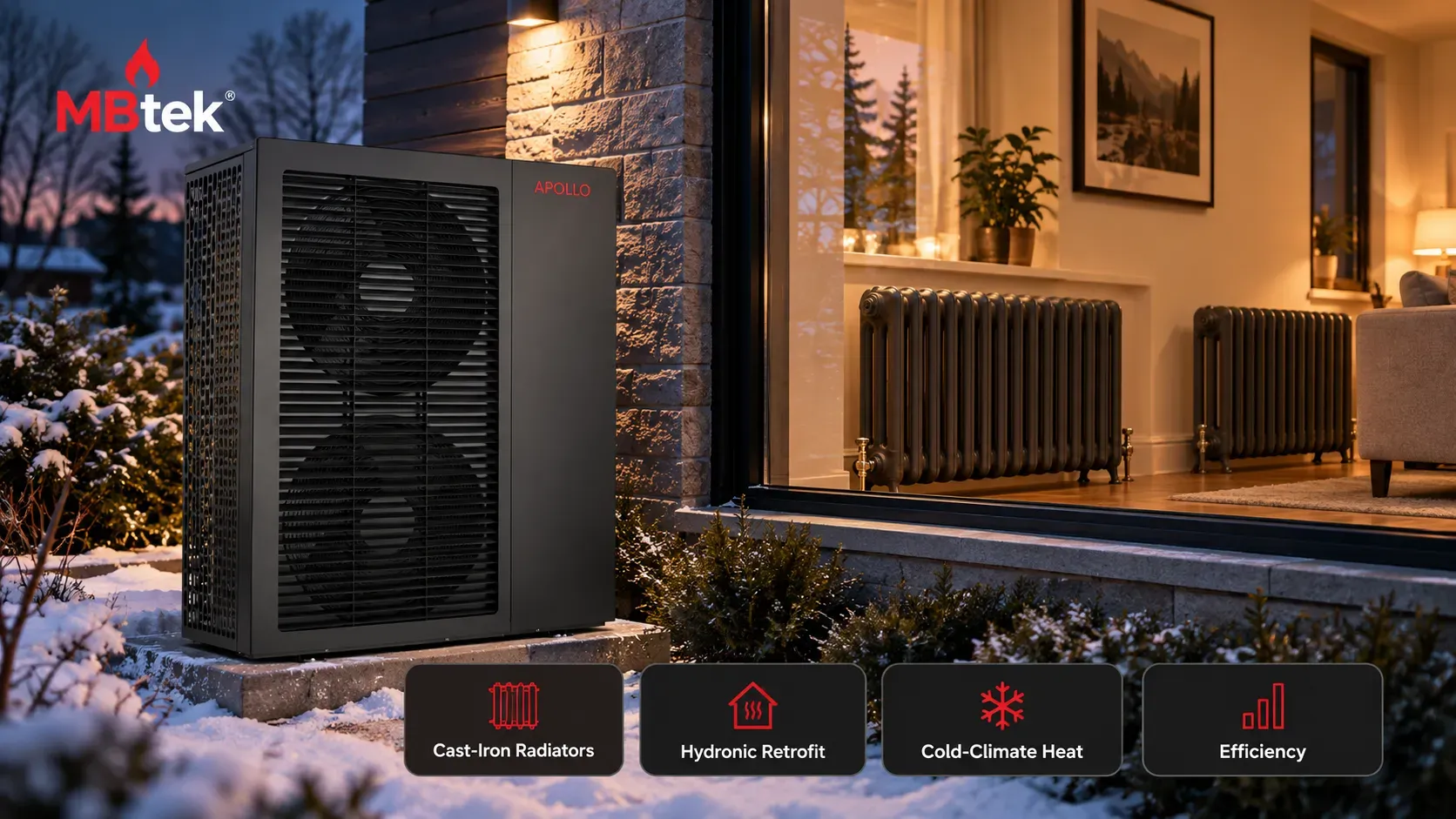
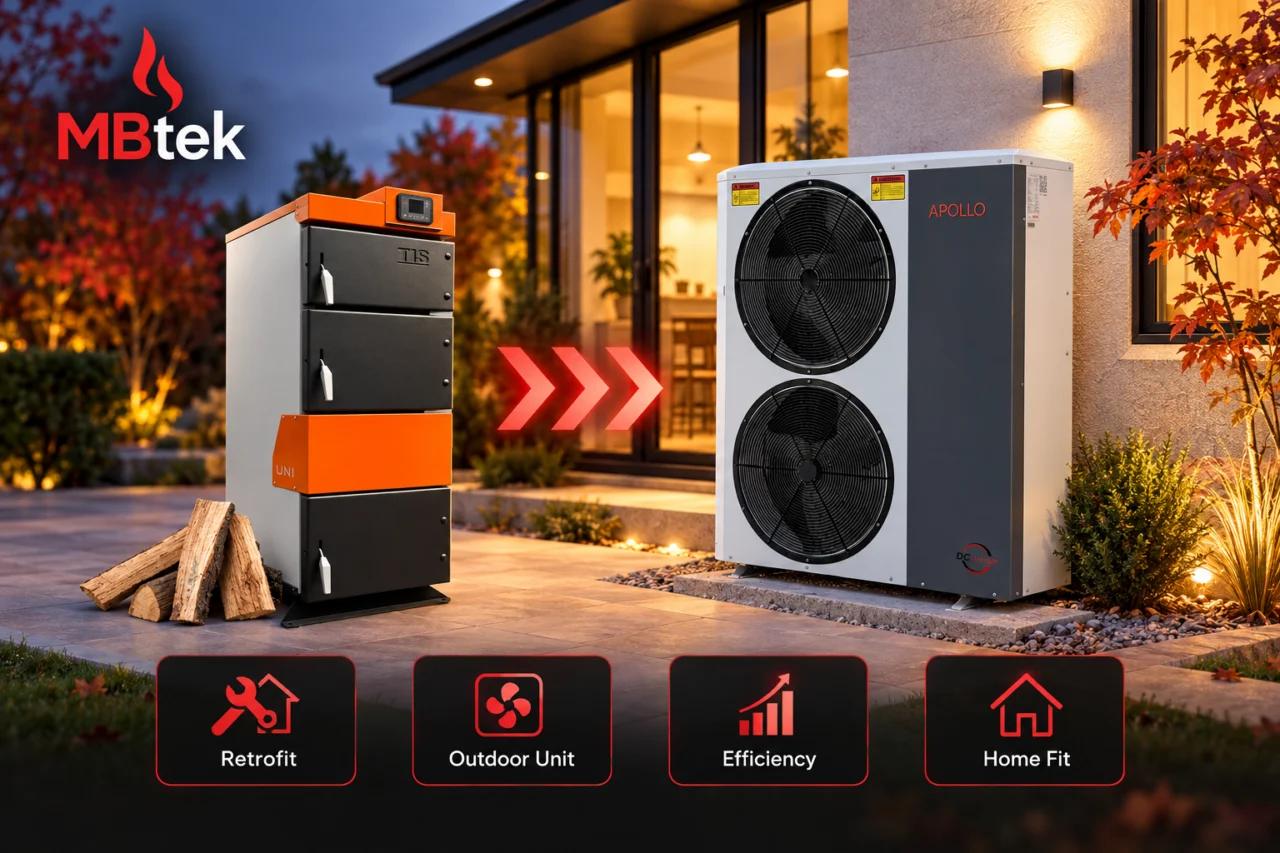
Yes, a heat pump can replace a boiler in many homes, especially when the home already has a hot-water hydronic heating system.
An air-to-water heat pump takes heat from outdoor air and transfers it to water that circulates through radiant floors, fan coils, air handlers, radiators, or compatible hydronic baseboards. It uses electricity to move heat rather than burning gas, oil, propane, wood, or pellets.
Replacing a boiler is not always a simple appliance swap. The right design depends on the building's heat loss, the water temperature its emitters need, local winter conditions, domestic hot water, and the electrical service.
Boiler vs. air-to-water heat pump
A boiler and an air-to-water heat pump can both supply hot water to a hydronic system, but they produce heat differently.
| Boiler | Air-to-water heat pump | |
|---|---|---|
| Heat source | Gas, oil, propane, wood, pellets, or electricity | Outdoor air and electricity |
| Hydronic hot water | Yes | Yes |
| Radiant floors and fan coils | Yes | Yes |
| Radiators and baseboards | Common application | Depends on system design and model |
| Cooling | No | Possible with compatible equipment |
| Combustion and flue | Usually required for fuel-burning boilers | No combustion |
| Performance in cold weather | Less directly affected by outdoor temperature | Capacity and efficiency vary with outdoor and water temperatures |
| Domestic hot water | Common | Possible with a compatible tank and controls |
- Heat source
- Boiler
- Gas, oil, propane, wood, pellets, or electricity
- Air-to-water heat pump
- Outdoor air and electricity
- Hydronic hot water
- Boiler
- Yes
- Air-to-water heat pump
- Yes
- Radiant floors and fan coils
- Boiler
- Yes
- Air-to-water heat pump
- Yes
- Radiators and baseboards
- Boiler
- Common application
- Air-to-water heat pump
- Depends on system design and model
- Cooling
- Boiler
- No
- Air-to-water heat pump
- Possible with compatible equipment
- Combustion and flue
- Boiler
- Usually required for fuel-burning boilers
- Air-to-water heat pump
- No combustion
- Performance in cold weather
- Boiler
- Less directly affected by outdoor temperature
- Air-to-water heat pump
- Capacity and efficiency vary with outdoor and water temperatures
- Domestic hot water
- Boiler
- Common
- Air-to-water heat pump
- Possible with a compatible tank and controls
Heat pumps move heat using electricity. Their heating efficiency is often described by a coefficient of performance (COP). A COP of 3 means the system delivers about three units of heat for each unit of electricity used under the measured conditions. COP changes with outdoor temperature and the water temperature the system must produce.
For products covered by ENERGY STAR's current cold-climate criteria, the requirements include a COP of at least 1.75 at 5°F and at least 70% of the rated 47°F heating capacity at 5°F. These criteria apply to qualifying equipment in that program; check the exact product listing and test conditions when comparing systems. (ENERGY STAR cold-climate criteria)
The key question: What water temperature does your home need?
This is often the deciding factor in a boiler-to-heat-pump retrofit. Many older hydronic systems were designed around boilers that can supply very hot water. A heat pump generally operates more efficiently when it can meet the load with cooler water.
| Typical retrofit fit | |
|---|---|
| Radiant floor heating | Often an excellent fit because it can use lower water temperatures |
| Fan coils or hydronic air handlers | Often a good fit when selected for the heat pump's water temperatures |
| Modern low-temperature radiators | Often a good fit after checking output against the building load |
| Oversized cast-iron radiators | May work well at lower temperatures, but needs evaluation |
| Conventional fin-tube baseboards | Requires careful output and water-temperature review |
| Small radiators sized for very hot water | May need upgrades or supplemental heat |
| Steam radiators | Not a direct replacement for a hot-water heat pump |
- Radiant floor heating
- Typical retrofit fit
- Often an excellent fit because it can use lower water temperatures
- Fan coils or hydronic air handlers
- Typical retrofit fit
- Often a good fit when selected for the heat pump's water temperatures
- Modern low-temperature radiators
- Typical retrofit fit
- Often a good fit after checking output against the building load
- Oversized cast-iron radiators
- Typical retrofit fit
- May work well at lower temperatures, but needs evaluation
- Conventional fin-tube baseboards
- Typical retrofit fit
- Requires careful output and water-temperature review
- Small radiators sized for very hot water
- Typical retrofit fit
- May need upgrades or supplemental heat
- Steam radiators
- Typical retrofit fit
- Not a direct replacement for a hot-water heat pump
Radiant floors are usually well suited to heat pumps because their large surface area can deliver room heat with comparatively cool water. Existing radiators and baseboards need more investigation, but their presence alone does not rule out a conversion.
Can a heat pump work with existing radiators?
Often, yes. Older cast-iron radiators may have more capacity than a home currently needs, especially if insulation, windows, or air sealing have improved since the heating system was installed.
A contractor should compare the building's design heat loss with each radiator's output at the water temperatures the heat pump can efficiently provide. If the existing radiators do not deliver enough heat, options include:
- Adding or replacing selected radiators.
- Adding fan coils in rooms that need more output.
- Improving insulation and air sealing to reduce the heating load.
- Selecting a heat pump designed for higher water temperatures.
- Keeping the boiler for supplemental heat during specific conditions.
Do not assume every radiator must be replaced before the system is evaluated.
What about hydronic baseboards?
Conventional fin-tube baseboards can be more challenging because their output drops as water temperature falls. The important comparison is the home's current heat demand against the total output of the installed baseboards at the proposed water temperature.
For example, a home with more baseboard capacity than its current design heat loss requires may have room to operate at cooler water temperatures. A home already using nearly all its baseboard capacity may need additional emitters, envelope improvements, a high-temperature heat pump, or supplemental heat.
High-temperature heat pumps widen retrofit options
High-temperature air-to-water heat pumps can make more existing hydronic systems practical to convert. The APOLLO MAX line is listed for applications including radiators and baseboards, with water temperatures up to 175°F (80°C) and an operating range down to -31°F (-35°C). Actual capacity and efficiency depend on operating conditions; maximum temperature and low-ambient operation are equipment limits, not a recommendation to run continuously at the highest water temperature. (APOLLO MAX specifications)
For one current example, the APOLLO MAX 5 Ton product listing gives 63.1 kBTU of heating at 41°F and 51 kBTU at 10°F. The listed output and COP are tied to those test conditions, so compare performance data at the outdoor and water temperatures expected for the project rather than relying on nominal tonnage alone.
Size the heat pump from the building's heat loss
Do not size a replacement heat pump just by copying the BTU rating on the existing boiler. Older boilers are often oversized, and the boiler's input rating does not say how much heat the building needs at its winter design temperature.
Start with a room-by-room or whole-building heat-loss calculation that considers:
- Local outdoor design temperature and the desired indoor temperature.
- Building dimensions, ceiling heights, and exposed wall area.
- Insulation, windows, and air leakage.
- The output of each radiator, baseboard, or other emitter.
- The supply-water temperature needed on the coldest design day.
Then compare the heat pump's heating capacity at those outdoor and water temperatures with the building load. See the heat pump size chart for more on load-based selection.
What if the boiler also makes domestic hot water?
Include domestic hot water (DHW) in the retrofit design. Removing a boiler that heats both the home and the hot-water tank without replacing its DHW function can leave the household without enough hot water.
An air-to-water heat pump can be designed to work with a compatible tank, controls, and, when needed, auxiliary heat. Tank size, recovery time, priority controls, and household demand should be considered alongside space heating. See the hydronic heat-pump hot-water guide for more detail.
Can the heat pump replace the air conditioner too?
Potentially. A reversible air-to-water heat pump can provide chilled water in summer for compatible fan coils or hydronic air handlers. Radiators and conventional baseboards generally are not cooling emitters; surfaces below the room's dew point can collect condensation.
Cooling should be included in the system design from the start. The equipment, controls, and indoor emitters all need to support it.
When does a complete boiler replacement make sense?
A full conversion may be attractive when the existing boiler is near the end of its service life, the building has low-temperature emitters or can use them effectively, the heat pump can meet the design load, and the electrical service supports the equipment.
It may also appeal to homeowners who want to eliminate onsite combustion, reduce fuel handling, or add hydronic cooling with compatible equipment. Compare local electricity and fuel costs using realistic heat-pump performance for the home's required water temperatures.
When should you keep the boiler?
A hybrid heat-pump-and-boiler system can make sense when the boiler is still in good condition, the home needs very hot water at design conditions, or the heat pump can cover most but not all of the winter load.
The controls can be designed so the heat pump handles much of the season while the boiler assists under defined conditions. Whether that saves money or improves resilience depends on local energy prices, the building, equipment, and system controls. For a broader comparison, see heat pump vs. boiler: choosing a heating system.
Boiler-to-heat-pump retrofit checklist
Before removing the boiler, confirm:
- Building heat loss: How many BTU/h does the building need at the local design temperature?
- Emitter output: Can existing radiators or baseboards meet that load?
- Water temperature: What supply temperature is required on the coldest design day?
- Heat-pump capacity: What does the selected model deliver under those conditions?
- Electrical service: Can the home's service support the heat pump and any auxiliary heat?
- Domestic hot water: How will the new system meet household hot-water demand?
- Backup strategy: Is supplemental or hybrid heat needed for peak conditions?
- Controls and storage: Do the design and emitters require a buffer tank, mixing controls, or additional pumps?
- Cooling: Are the indoor emitters suitable for chilled water, if cooling is part of the project?
These details matter more than comparing the boiler's nameplate rating with a heat pump's nominal BTU number.
Can a heat pump replace your boiler?
For many homes with hot-water hydronic heating, yes. Radiant floors, fan coils, and low-temperature radiators are often natural fits. Traditional radiators and baseboards need an output and water-temperature review, and high-temperature models can make more retrofit projects possible.
Start with the building's heat loss, then check the existing emitters, required water temperature, winter capacity, electrical service, and domestic hot water. The result may be a complete boiler replacement, a few targeted emitter upgrades, or a hybrid system that keeps the boiler for supplemental heat.
The goal is to design a hydronic system that meets the home's load throughout the year, not simply to exchange one appliance for another.
Common questions
Frequently asked questions
Can I keep my existing radiators with a heat pump?+
Often. A contractor should compare the building's heat loss with each radiator's output at the supply-water temperatures the heat pump will use. Some systems work as-is; others need selected emitter upgrades or supplemental heat.
Can an air-to-water heat pump make domestic hot water?+
Yes, when the system is designed with a compatible hot-water tank, controls, and any needed auxiliary heat. Tank capacity and recovery should be planned with the home's space-heating demand.
Does my new heat pump need to match the old boiler's BTU rating?+
No. Size the heat pump from a heat-loss calculation and its capacity at local winter conditions. The existing boiler may be oversized, and its nameplate input is not the building's heat-loss result.
Should I remove the boiler completely?+
Not always. A hybrid system can keep a working boiler for peak loads or high-temperature conditions while the heat pump covers much of the heating season. The right design depends on the building, equipment, controls, and local energy costs.