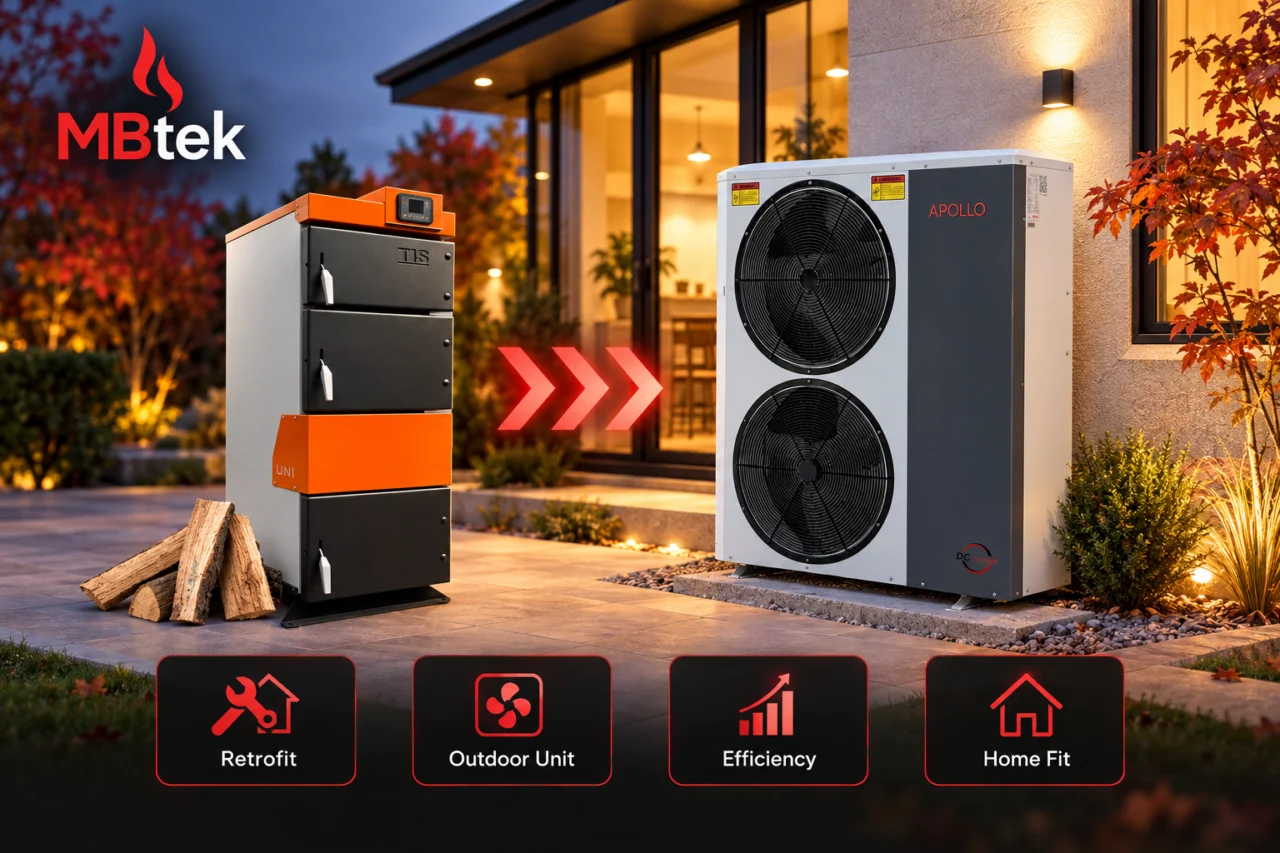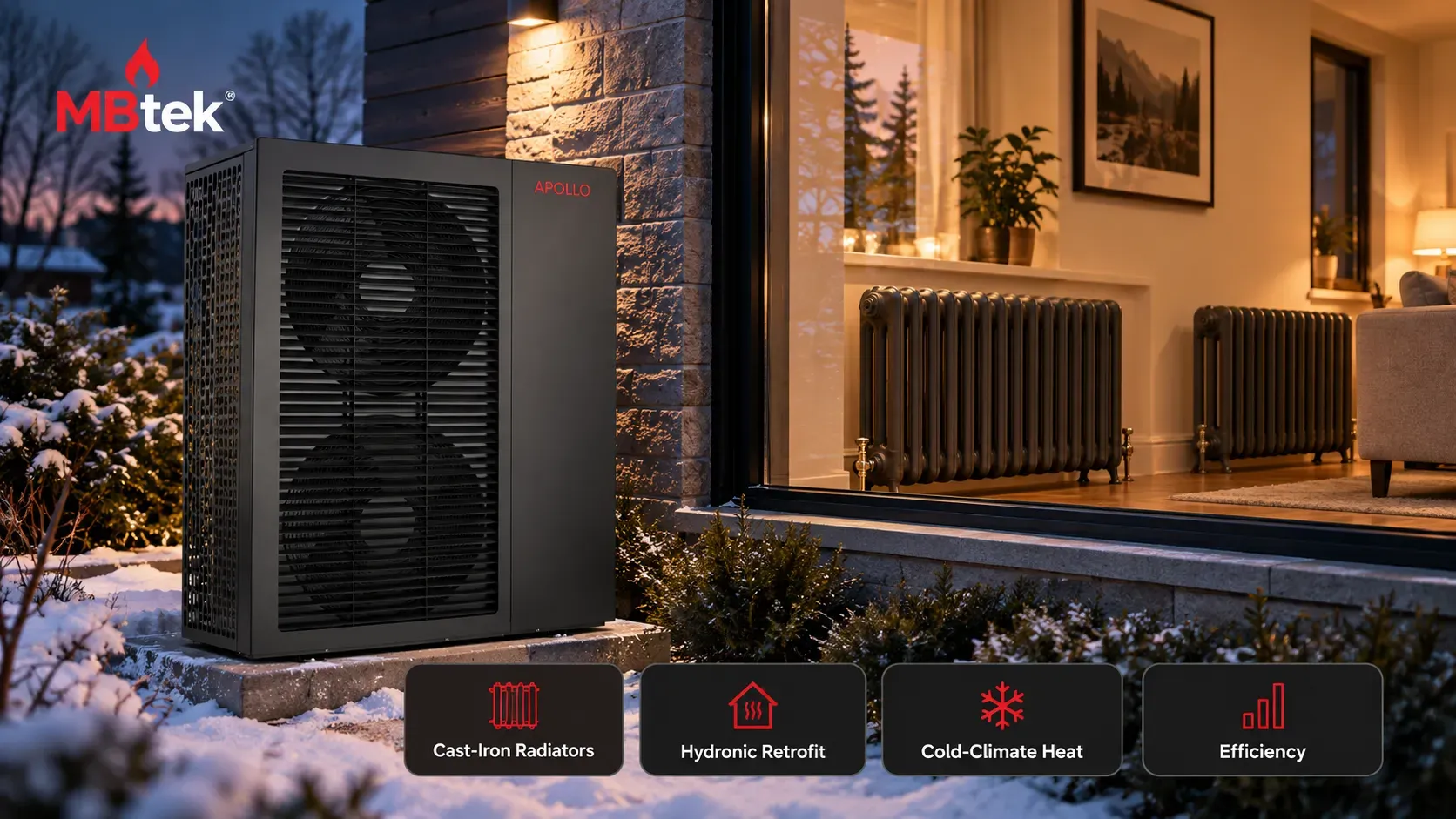
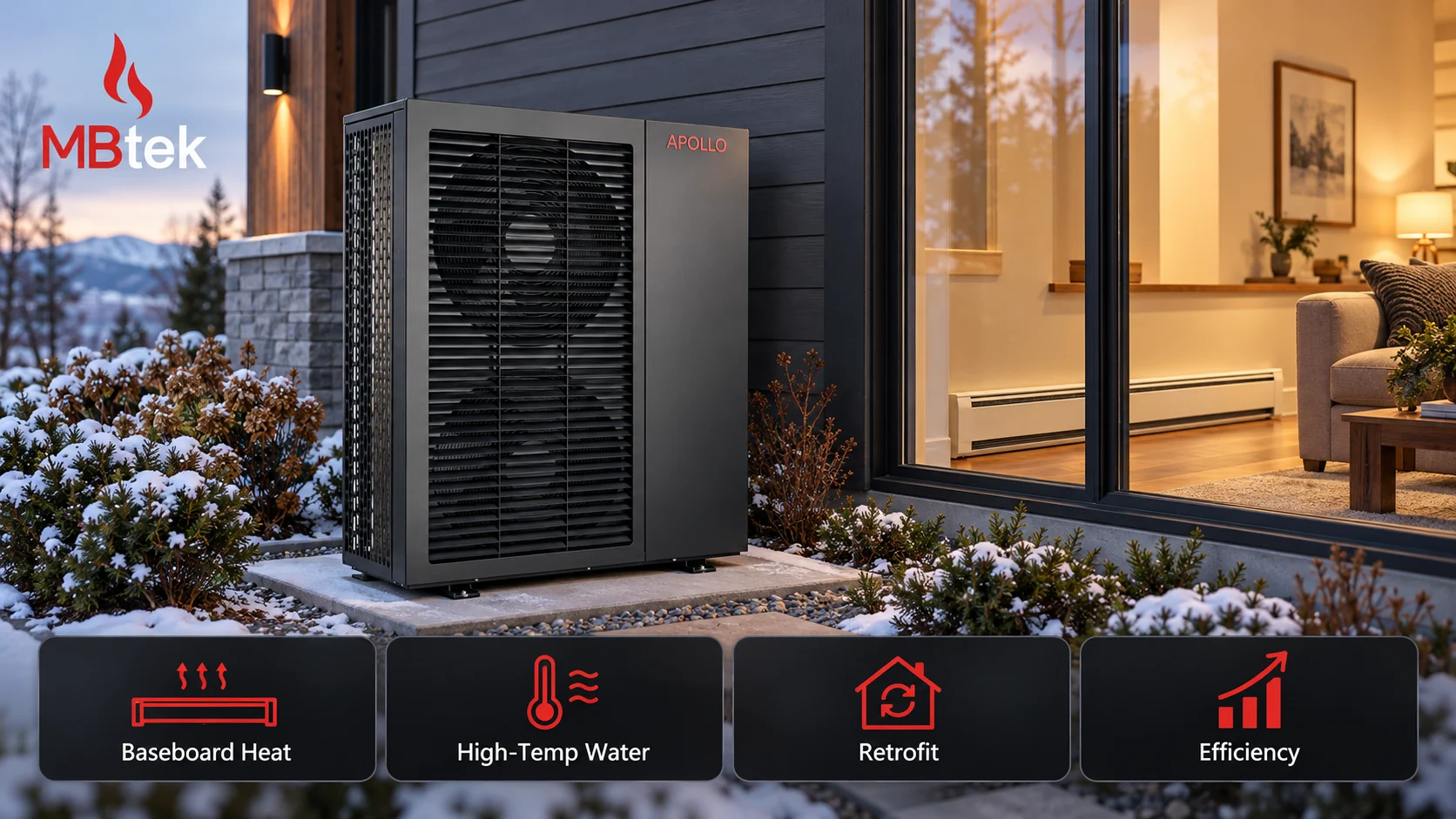
Yes, a heat pump can work with hot-water baseboard heating, but whether you can reuse your existing baseboards depends mainly on one thing: how much heat they can deliver at the water temperature produced by the heat pump.
This is especially important in homes replacing an oil, gas or propane boiler. Traditional boilers commonly supply very hot water, while heat pumps generally operate more efficiently at lower temperatures.
That does not mean you automatically need to replace your baseboards.
In some homes, the existing system has enough baseboard length to heat the building at lower temperatures. In others, a high-temperature heat pump, additional baseboard or a few upgraded emitters may be required.
Can an Air-to-Water Heat Pump Run Baseboard Heat?
If you have hydronic or hot-water baseboards, yes.
An air-to-water heat pump heats water and circulates it through the same type of hydronic distribution system used by a boiler.
It can potentially supply:
- Hot-water baseboards
- Radiators
- Radiant floors
- Fan coil units
- Hydronic air handlers
The important distinction is between hot-water baseboards and electric baseboards.
| Can an Air-to-Water Heat Pump Use It? | |
|---|---|
| Hot-water / hydronic baseboard | Yes, if output is sufficient |
| Low-temperature hydronic baseboard | Excellent application |
| Electric resistance baseboard | No direct connection |
| Hydronic baseboard requiring very high temperatures | May require a high-temperature heat pump |
- Hot-water / hydronic baseboard
- Can an Air-to-Water Heat Pump Use It?
- Yes, if output is sufficient
- Low-temperature hydronic baseboard
- Can an Air-to-Water Heat Pump Use It?
- Excellent application
- Electric resistance baseboard
- Can an Air-to-Water Heat Pump Use It?
- No direct connection
- Hydronic baseboard requiring very high temperatures
- Can an Air-to-Water Heat Pump Use It?
- May require a high-temperature heat pump
Electric baseboard heaters contain resistance elements rather than water piping, so an air-to-water heat pump cannot simply be connected to them.
The Real Issue Is Water Temperature
Traditional residential fin-tube baseboard was generally designed around relatively high water temperatures.
Caleffi notes that standard fin-tube baseboard has historically been sized around 160°F to 200°F average water temperatures. Modern heat pumps, on the other hand, perform better when they do not have to produce extremely hot water.
However, baseboards do not suddenly stop working below those temperatures.
They simply produce less heat.
For example, Caleffi estimates that conventional residential fin-tube baseboard can still produce around 140 BTU/hr per foot at an average water temperature of 115°F under the conditions used in its example.
That can be enough in some homes and far too little in others.
Why baseboard length matters
Imagine one room requires 5,000 BTU/h on the coldest winter day.
If its baseboard produces:
| Baseboard Length Needed for 5,000 BTU/h | |
|---|---|
| 500 BTU/hr/ft | 10 ft |
| 300 BTU/hr/ft | ~17 ft |
| 200 BTU/hr/ft | 25 ft |
| 140 BTU/hr/ft | ~36 ft |
- 500 BTU/hr/ft
- Baseboard Length Needed for 5,000 BTU/h
- 10 ft
- 300 BTU/hr/ft
- Baseboard Length Needed for 5,000 BTU/h
- ~17 ft
- 200 BTU/hr/ft
- Baseboard Length Needed for 5,000 BTU/h
- 25 ft
- 140 BTU/hr/ft
- Baseboard Length Needed for 5,000 BTU/h
- ~36 ft
This simplified example shows why two homes with identical heat pumps can have completely different retrofit requirements.
One may already have plenty of baseboard. Another may need more emitter capacity.
Will Your Existing Baseboards Work?
The best way to find out is to compare building heat loss with baseboard output.
You need to know:
- How many BTU/h each room requires
- How many feet of active baseboard are installed
- How much heat that baseboard produces at different water temperatures
- The heat pump's output during your coldest design weather
Do not assume the rating of your old boiler tells you the answer.
A home with a 120,000 BTU boiler may have an actual design heating load far below 120,000 BTU/h. Boilers were often oversized, and insulation, windows or air sealing may have improved since the original system was installed.
That can make the existing baseboard more useful than expected.
A practical first test with an existing boiler is also to gradually lower its water temperature during cold weather and see whether the house remains comfortable. A professional heat-loss calculation and emitter assessment is still the better basis for final design.
High-Temperature Heat Pumps Make Baseboard Retrofits Easier
If your existing baseboard requires hotter water, a conventional low-temperature heat pump may not be the right choice.
That is where high-temperature air-to-water heat pumps become useful.
MBTEK's APOLLO MAX series is specifically designed for hydronic applications including baseboards and radiators and can produce water temperatures up to 175°F (80°C). The current APOLLO MAX line is also rated for outdoor operation down to -31°F.
For example, the APOLLO MAX 4 Ton lists:
- 48,000 BTU nominal heating capacity
- Up to 175°F water
- Baseboard and radiator compatibility
- 41.6 kBTU output at 41°F
- 33.6 kBTU output at 10°F
- COP 4.8 at 41°F
- COP 3.5 at 10°F
The ability to reach 175°F does not mean the system should always run that hot.
A better design determines the lowest water temperature that will keep the house comfortable. Lower water temperatures generally make it easier for the heat pump to operate efficiently.
What If Your Existing Baseboard Is Not Enough?
You do not necessarily need to replace the entire heating system.
There are several ways to make a heat-pump retrofit work.
1. Add more baseboard
Increasing emitter length allows the same room to receive the required heat at a lower water temperature.
2. Install low-temperature baseboard
Some hydronic baseboards are specifically designed with greater fin area and multiple tubes to produce significantly more heat at lower water temperatures.
Caleffi gives an example of low-temperature baseboard producing about 532 BTU/hr per foot at 120°F entering water, substantially improving compatibility with heat pumps.
3. Add fan coils
A fan coil moves room air across a hydronic coil, allowing relatively high heat output at lower water temperatures.
It can also provide cooling when connected to a reversible air-to-water heat pump.
4. Improve the building envelope
Better insulation, windows and air sealing reduce the BTU/h the house requires.
Less heat demand means the existing baseboard can potentially operate at a lower water temperature.
5. Keep the boiler as backup
A hybrid system can use the heat pump for most of the heating season while retaining the boiler for exceptionally cold conditions or unusually high-temperature demand.
Heat Pump + Baseboard: What Should You Check First?
Before replacing your boiler, check these five things:
- Calculate the home's actual heat loss. Do not size the new system from the old boiler alone.
- Measure the active baseboard length in each room. The metal enclosure length is not always the same as active fin-tube length.
- Determine the required water temperature. Calculate baseboard output at 120°F, 140°F, 160°F and other relevant temperatures.
- Check heat-pump capacity in cold weather. Look at actual output at 10°F, 0°F or your local design temperature—not just nominal tonnage.
- Decide whether selective upgrades make sense. Adding one fan coil or several feet of baseboard may be more practical than designing the entire system around very high water temperatures.
So, Will a Heat Pump Work With Baseboard Heating?
Yes—especially if the baseboard is hydronic and the system is properly evaluated.
The question is not simply whether a heat pump can produce hot water. It can.
The real question is whether your existing baseboards can provide enough heat at a water temperature that makes sense for the heat pump.
Homes with generous baseboard length, lower heating loads or improved insulation can sometimes reuse their existing distribution system with minimal changes.
Where higher temperatures are necessary, modern high-temperature equipment such as APOLLO MAX expands the range of homes that can switch from a boiler to an air-to-water heat pump without replacing the entire hydronic system.
Before replacing anything, start with three numbers:
building heat loss, installed baseboard length and required water temperature.
Those will tell you whether your existing baseboards are already ready for a heat pump—or what needs to change to make them work.