When both systems run on electricity, it is easy to assume that a heat pump and electric baseboard heaters should consume roughly the same amount of energy.
They do not.
Electric baseboard heating uses electrical resistance to turn electricity directly into heat. A heat pump uses electricity to move existing heat from outdoors into the home. Because of this fundamental difference, a properly installed heat pump can deliver several times as much heat for the same amount of electricity.
The U.S. Department of Energy states that today's heat pumps can reduce electricity use for heating by up to 75% compared with electric resistance systems such as electric baseboards. DOE's home-upgrade guidance uses a more conservative typical figure of approximately 65%. The Department of Energy's Energy.gov
That can make replacing electric baseboard heating with a heat pump one of the most significant efficiency upgrades available to an electrically heated home.
But the exact savings depend on the heat pump, climate, building heat loss and the temperature at which the system has to operate.
Heat Pump Energy Use Compared to Electric Baseboard: Quick Answer
Electric baseboard heaters effectively operate at a COP of about 1: approximately 1 kWh of electricity becomes 1 kWh of heat inside the building.
A heat pump might operate at a COP of 2, 3, 4 or higher depending on conditions.
That produces a simple comparison:
| Approx. COP | Electricity Required for 10,000 kWh of Heat | |
|---|---|---|
| Electric baseboard | 1.0 | 10,000 kWh |
| Heat pump at COP 2 | 2.0 | 5,000 kWh |
| Heat pump at COP 3 | 3.0 | 3,333 kWh |
| Heat pump at COP 4 | 4.0 | 2,500 kWh |
- Electric baseboard
- Approx. COP
- 1.0
- Electricity Required for 10,000 kWh of Heat
- 10,000 kWh
- Heat pump at COP 2
- Approx. COP
- 2.0
- Electricity Required for 10,000 kWh of Heat
- 5,000 kWh
- Heat pump at COP 3
- Approx. COP
- 3.0
- Electricity Required for 10,000 kWh of Heat
- 3,333 kWh
- Heat pump at COP 4
- Approx. COP
- 4.0
- Electricity Required for 10,000 kWh of Heat
- 2,500 kWh
This example does not represent the seasonal performance of every heat pump. It simply shows why a heat pump can use substantially less electricity than resistance baseboard heating to deliver the same amount of heat.
Are Heat Pumps More Efficient Than Electric Baseboard Heaters?
Yes.
Electric resistance heating is already highly efficient at converting electricity into heat at the point of use. DOE modeling treats electric baseboard heating as essentially 100% efficient inside the conditioned space. EERE Energy
That sounds difficult to beat until you consider what a heat pump is actually doing.
A heat pump is not limited to converting one unit of electricity into one unit of heat. It uses electricity to operate a refrigeration cycle that collects thermal energy from outside and moves it indoors.
For example:
- Electric baseboard: 1 kWh electricity → roughly 1 kWh heat
- COP 2 heat pump: 1 kWh electricity → roughly 2 kWh heat
- COP 3 heat pump: 1 kWh electricity → roughly 3 kWh heat
- COP 4 heat pump: 1 kWh electricity → roughly 4 kWh heat
This is why heat pumps can dramatically reduce heating electricity consumption without violating the laws of thermodynamics: much of the delivered energy comes from outdoor heat rather than from the electrical grid.
Heat Pump vs Electric Baseboard Cost
Because both systems use electricity, the operating-cost calculation is particularly straightforward.
Imagine electricity costs $0.15/kWh and the house requires 10,000 kWh of useful heating energy.
| Electricity Use | Illustrative Heating Cost | |
|---|---|---|
| Electric baseboard | 10,000 kWh | $1,500 |
| Heat pump — COP 2 | 5,000 kWh | $750 |
| Heat pump — COP 3 | 3,333 kWh | ~$500 |
| Heat pump — COP 4 | 2,500 kWh | $375 |
- Electric baseboard
- Electricity Use
- 10,000 kWh
- Illustrative Heating Cost
- $1,500
- Heat pump — COP 2
- Electricity Use
- 5,000 kWh
- Illustrative Heating Cost
- $750
- Heat pump — COP 3
- Electricity Use
- 3,333 kWh
- Illustrative Heating Cost
- ~$500
- Heat pump — COP 4
- Electricity Use
- 2,500 kWh
- Illustrative Heating Cost
- $375
At a COP of 3, the heat pump uses roughly two-thirds less electricity than resistance heating in this simplified example.
Actual annual savings will vary because a heat pump's COP is not constant throughout winter.
Outdoor temperature, supply-water temperature, compressor modulation, defrost cycles and building load all affect real-world energy consumption.
Is a Heat Pump Better Than Electric Baseboard in Winter?
Usually, but winter conditions matter.
As outdoor temperatures fall, an air-source heat pump has to work harder to move heat indoors. Heating capacity and COP can therefore decline during very cold conditions.
Modern cold-climate equipment is specifically designed to mitigate this problem.
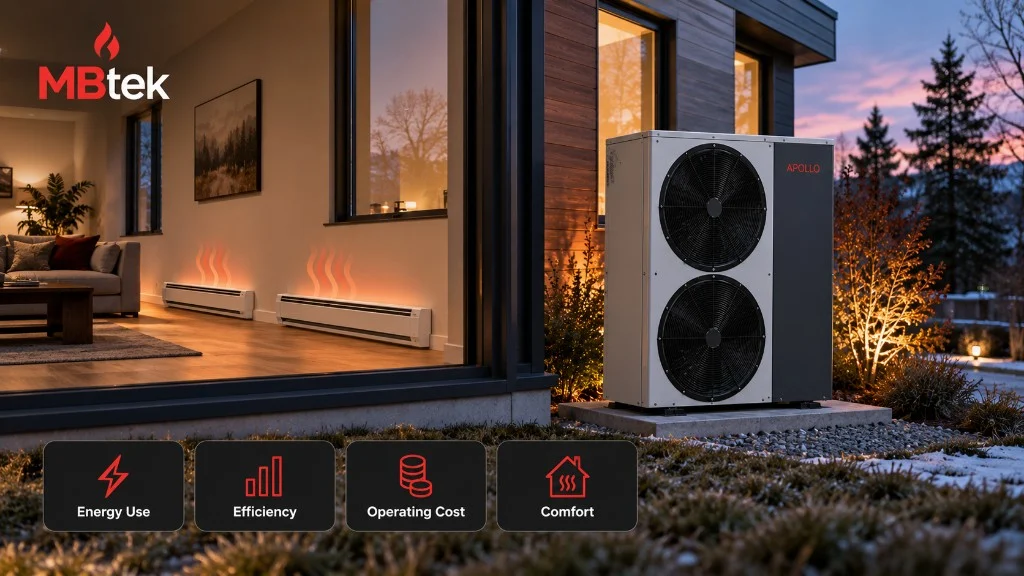
For example, MBTEK's APOLLO MAX 4 Ton air-to-water heat pump publishes a COP of 4.8 at an outdoor temperature of 41°F and 3.5 at 10°F under its listed rating conditions. It is rated for operation down to -31°F. APOLLO MAX 4 Ton
Those numbers also illustrate an important point: even when COP falls as outdoor temperatures decrease, a heat pump may still be delivering substantially more heat per kWh than electric resistance heating.
However, actual performance depends on more than outdoor temperature. With an air-to-water system, the required water temperature can also have a major impact on efficiency.
Electric Baseboard vs Hot-Water Baseboard: An Important Difference
"Baseboard heating" can refer to two very different systems.
Electric baseboard heaters
These contain electric resistance elements and are connected directly to the home's electrical system.
There is no circulating water.
An air-to-water heat pump cannot simply be connected to these existing heaters. Converting from electric baseboard heating would require a new hydronic distribution system, fan coils, radiant heating or another compatible heat emitter.
Hot-water baseboards
Hydronic baseboards contain tubing through which heated water circulates.
These can potentially be supplied by an air-to-water heat pump.
This distinction is especially important when researching terms such as "baseboard heat pump" or "heat pump with baseboard."
Can You Use a Heat Pump With Hot-Water Baseboard?
Yes, but the required water temperature must be evaluated.
Traditional fin-tube baseboard systems were often designed around high boiler temperatures. Reducing water temperature also reduces the amount of heat the baseboard can release into a room.
Caleffi demonstrates, for example, that conventional fin-tube baseboard can still emit heat at much lower temperatures, but its output per foot decreases substantially. Caleffi S.p.a.
That means a contractor should compare:
- The building's actual heat loss
- Existing baseboard length
- Baseboard output at different water temperatures
- The heat pump's output during design winter conditions
Sometimes the existing baseboard is sufficiently oversized to operate at lower temperatures. Other homes may need additional baseboard, panel radiators or fan coils.
High-temperature equipment provides another option. The APOLLO MAX series is designed for hydronic applications such as baseboards and radiators, with leaving-water temperatures up to 175°F (80°C) depending on the model and operating conditions. See the APOLLO MAX 4 Ton listing and the heat pump size chart.
Converting Electric Baseboard to a Heat Pump
Replacing electric baseboard heaters does not necessarily mean replacing them with another wall-mounted heating appliance.
There are several possible approaches.
Ductless heat pump: Indoor mini-split heads directly heat individual areas. This is a common retrofit because it does not require installing ductwork or hydronic piping.
Ducted heat pump: Appropriate when existing ducts are available or when installing new ductwork makes sense.
Air-to-water heat pump: Instead of heating indoor air directly, the heat pump produces hot water for a hydronic system.
An air-to-water retrofit can supply:
- Radiant floor heating
- Hydronic baseboards
- Panel radiators
- Fan coil units
- Air handlers
- Domestic hot water with the appropriate system design
For a major renovation or a home where a hydronic system is desirable, this can provide a more integrated solution than simply replacing electric baseboards room by room.
Heat Pump vs Baseboard Efficiency Depends on Water Temperature Too
For an air-to-water heat pump, lower water temperatures generally make the refrigeration cycle's job easier.
This makes radiant floor heating particularly attractive because radiant systems can often operate at relatively low supply temperatures.
Traditional fin-tube baseboards may require hotter water.
Caleffi notes that increasing the available emitter surface area can reduce the required water temperature. Low-temperature baseboard, panel radiators and fan coils are therefore useful options when designing a hydronic system around a heat pump. Caleffi S.p.a.
A good system design therefore asks:
What is the lowest water temperature that can still heat the house comfortably on the coldest design day?
Reducing that temperature can improve heat-pump efficiency and lower electricity consumption.
Are Heat Pumps Cheaper Than Baseboard Heaters?
In operating cost, usually yes when comparing a heat pump with electric resistance baseboard heating.
The biggest uncertainty is not whether a heat pump uses electricity more efficiently—it does—but whether the energy savings justify the installation cost for a particular home.
Electric baseboards have several advantages:
- Very low equipment cost
- Simple installation
- Individual room control
- Almost no mechanical maintenance
Their weakness is operating efficiency.
Heat pumps cost considerably more to install but can reduce electricity consumption throughout every heating season. Reversible heat pumps can also provide air conditioning during summer, potentially replacing a separate cooling system.
The longer the heating season and the higher the home's heating demand, the more important that difference in energy consumption becomes.
Should You Replace Electric Baseboard Heaters With a Heat Pump?
For a home that relies heavily on electric resistance heating, a heat pump is worth serious consideration.
The Department of Energy identifies heat pumps as a substantially more energy-efficient alternative to electric baseboard heating and notes that modern air-source technology is now suitable for much colder climates than earlier generations. The Department of Energy's Energy.gov
Before converting, evaluate:
- Annual baseboard electricity consumption
- Local electricity price
- Building heat loss
- Winter design temperature
- Existing electrical service
- Whether you want heating only or heating plus cooling
- Whether ductless, ducted or hydronic distribution makes the most sense
- Required water temperature if using hydronic baseboards
For MBTEK's air-to-water approach, homes with electric baseboards will typically need new hydronic emitters, while homes that already have hot-water baseboard heating may be able to reuse much of their existing distribution system.
The important distinction is that both systems may be electric, but they do not use electricity in the same way.
Electric baseboard heating turns electricity directly into heat. A heat pump uses electricity to move heat.
That difference is why heat pump energy use can be dramatically lower—and why converting from electric resistance heating can deliver meaningful long-term energy savings.