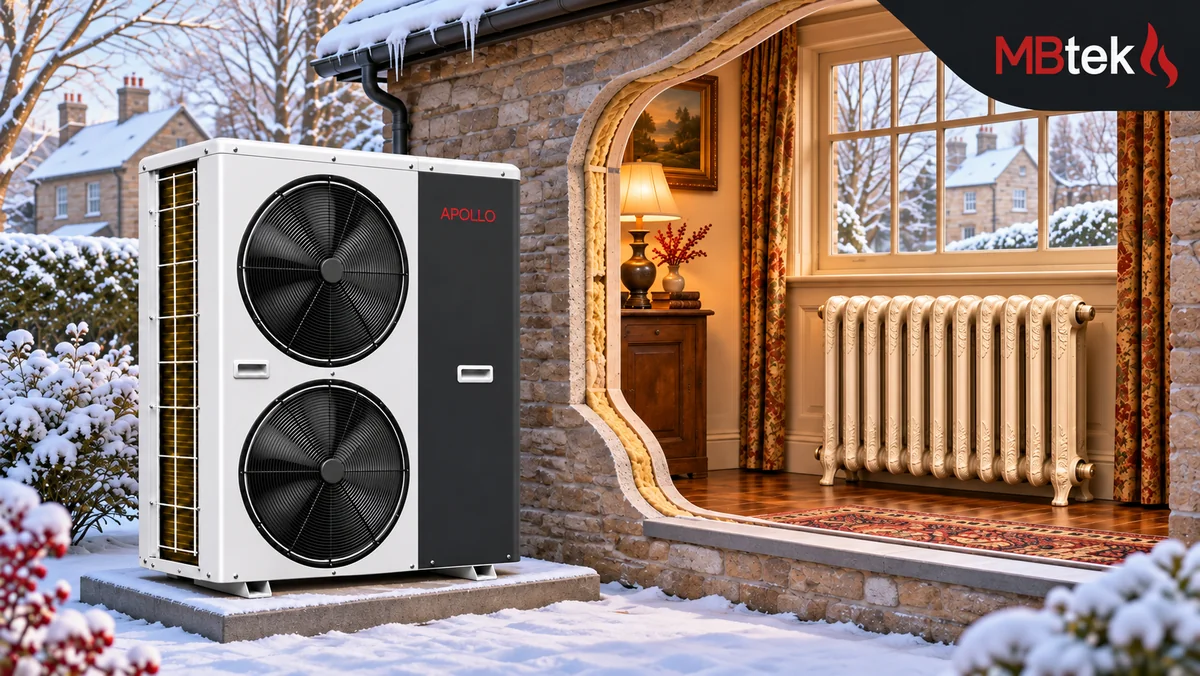
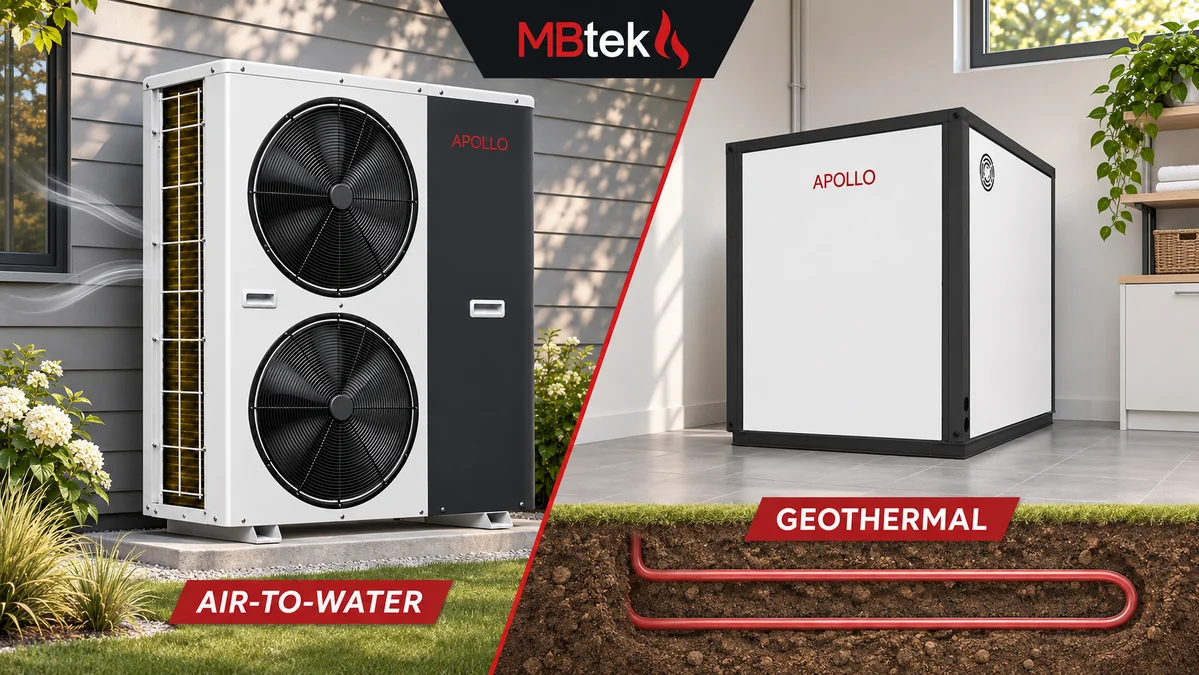
Air-to-water usually costs less to install. Geothermal can use less electricity over the year, especially where winters are long and the ground loop is well designed. Both can heat radiant floors or supply fan coils. The choice often comes down to two things you can check before picking a model: what your property can accommodate and how hot your heating water needs to be.
How air-to-water and geothermal heat pumps work
An air-to-water heat pump pulls heat from outdoor air and transfers it to water that circulates through your home. The outdoor unit needs airflow, and its heating output changes with outdoor temperature and the temperature of the water it’s asked to deliver.
A water-to-water geothermal heat pump gets its heat from fluid circulating through a ground loop. The heat pump transfers that energy to a separate water circuit that serves the house. Ground temperatures generally swing less than outdoor air temperatures, which gives geothermal a more stable heat source through winter. U.S. Department of Energy geothermal guide
| Air-to-water | Water-to-water geothermal | |
|---|---|---|
| Where the heat comes from | Outdoor air | Fluid circulating through a ground loop |
| What goes on the property | Outdoor unit and piping to the house | Ground loop and an indoor heat pump |
| Upfront cost | Usually lower because there’s no ground loop to install | Usually higher because of trenching or drilling |
| Winter performance | Varies with outdoor air and required water temperature | Less exposed to outdoor temperature swings, with performance tied to loop design |
| How heat reaches the rooms | Radiant floors, fan coils, or other compatible hydronic equipment | Radiant floors, fan coils, or other compatible hydronic equipment |
- Where the heat comes from
- Air-to-water
- Outdoor air
- Water-to-water geothermal
- Fluid circulating through a ground loop
- What goes on the property
- Air-to-water
- Outdoor unit and piping to the house
- Water-to-water geothermal
- Ground loop and an indoor heat pump
- Upfront cost
- Air-to-water
- Usually lower because there’s no ground loop to install
- Water-to-water geothermal
- Usually higher because of trenching or drilling
- Winter performance
- Air-to-water
- Varies with outdoor air and required water temperature
- Water-to-water geothermal
- Less exposed to outdoor temperature swings, with performance tied to loop design
- How heat reaches the rooms
- Air-to-water
- Radiant floors, fan coils, or other compatible hydronic equipment
- Water-to-water geothermal
- Radiant floors, fan coils, or other compatible hydronic equipment
What drives the installed cost?
Ask for two quotes that heat the same rooms and cover the same work. A heat pump’s equipment price tells you little about what it will cost to connect it to your house.
Both quotes should cover the heat pump, pumps and controls, any tanks or indoor equipment the design calls for, and changes to the electrical service or distribution system. For air-to-water, check who’s responsible for the outdoor pad, piping, and freeze protection. For geothermal, check whether the quote includes the loop design, drilling or trenching, and restoring disturbed ground.
Picture two projects. At an existing home with a finished yard and a good spot beside the mechanical room, air-to-water may be the simpler installation. On a new build with an accessible lot and excavation already planned, it’s worth pricing a horizontal ground loop while the site is still open. A vertical loop may fit a smaller footprint if a drill rig can access the property. U.S. Department of Energy geothermal installation guide
Which heat pump is more efficient in winter?
Geothermal has an advantage when the ground loop can deliver a steadier source temperature through a long cold spell. An air-to-water unit has to work with the air outside, and it periodically uses energy to clear frost from the outdoor coil when conditions call for it. Both systems generally work more efficiently when the house can stay warm with lower water temperatures. U.S. Department of Energy heat pump design guide
COP is the amount of heat a heat pump delivers per unit of electricity it uses under a given set of conditions. For example, MBTEK publishes a heating COP of 4.8 for the APOLLO MAX 5 Ton air-to-water model at 41°F outdoor air, with water entering at 95°F and leaving at 131°F. That’s one test point. A geothermal COP measured with different source and water temperatures can’t tell you which system will cost less to run in your home. APOLLO MAX 5 Ton specifications
For a useful operating-cost comparison, ask each installer for estimated annual electricity use based on your climate and heating load. Have them include circulation pumps, defrost where applicable, and any backup heat. Then compare the expected running cost against the difference in installed price.
Which MBTEK APOLLO model fits your heating system?
| When to consider it | |
|---|---|
| APOLLO 6 Ton Air-to-Water | An outdoor unit for radiant floors, fan coils, or a hydronic air handler. MBTEK lists leaving water up to 131°F. |
| APOLLO MAX 5 Ton Air-to-Water | An option for projects that need hotter water, including some radiator and baseboard retrofits. MBTEK lists a maximum water outlet of 170°F. Ask what capacity it can deliver at your design conditions. |
| APOLLO Geothermal 6 Ton | A water-to-water option for a ground-loop system serving radiant floors, fan coils, or a hydronic air handler. MBTEK lists leaving water up to 131°F. |
| APOLLO Geothermal MAX 6 Ton | In MBTEK’s highest published heating test, water entered the unit at 122°F and left at 131°F. If you’re reusing radiators or baseboards, check how much heat the system can deliver at the water temperature your home needs. |
- When to consider it
- An outdoor unit for radiant floors, fan coils, or a hydronic air handler. MBTEK lists leaving water up to 131°F.
- When to consider it
- An option for projects that need hotter water, including some radiator and baseboard retrofits. MBTEK lists a maximum water outlet of 170°F. Ask what capacity it can deliver at your design conditions.
- When to consider it
- A water-to-water option for a ground-loop system serving radiant floors, fan coils, or a hydronic air handler. MBTEK lists leaving water up to 131°F.
- When to consider it
- In MBTEK’s highest published heating test, water entered the unit at 122°F and left at 131°F. If you’re reusing radiators or baseboards, check how much heat the system can deliver at the water temperature your home needs.
If you’re replacing a boiler, ask for a room-by-room heat-loss calculation and a check of the existing radiators or baseboards. Two rooms on the same loop may need different amounts of heat. If one room falls short at a lower water temperature, upgrading its radiator or baseboard may make it possible to run the whole loop cooler.
Which system should you get a quote for?
Start with air-to-water if you have a good location for an outdoor unit and want to limit site work. Price geothermal alongside it if the property can accommodate a ground loop and winter energy use is a major factor. Give both installers the same heat-loss calculation, list of indoor equipment, and comfort goals so you can compare what each quote actually delivers.