MBtek
APOLLO Wi-Fi Radiant Floor Thermostat

1 / 9

Wi-Fi Thermostat — Hydronic Radiant Floor

APOLLO Wi-Fi Radiant Floor Thermostat

Application-specific hydronic and HVAC control with touchscreen, app, BACnet, and MQTT connectivity.

Power
12 to 24V AC/DC
$361
$25330% OFF

Shipping$80Free

Save 30%
  • Free shipping
  • Secure checkout

Installed in real homes and workshops

Customer Success Stories

Upgrading standard dial thermostats to advanced Wi-Fi enabled digital thermostats for better energy tracking and remote access.

Complete Control with MBTEK Thermostat

SMART HOME • UPGRADE

Product details

  • 2.4GHz Wi-Fi control
  • Application-configured
  • Building integration
  • Touchscreen interface

APOLLO Wi-Fi Radiant Floor Thermostat

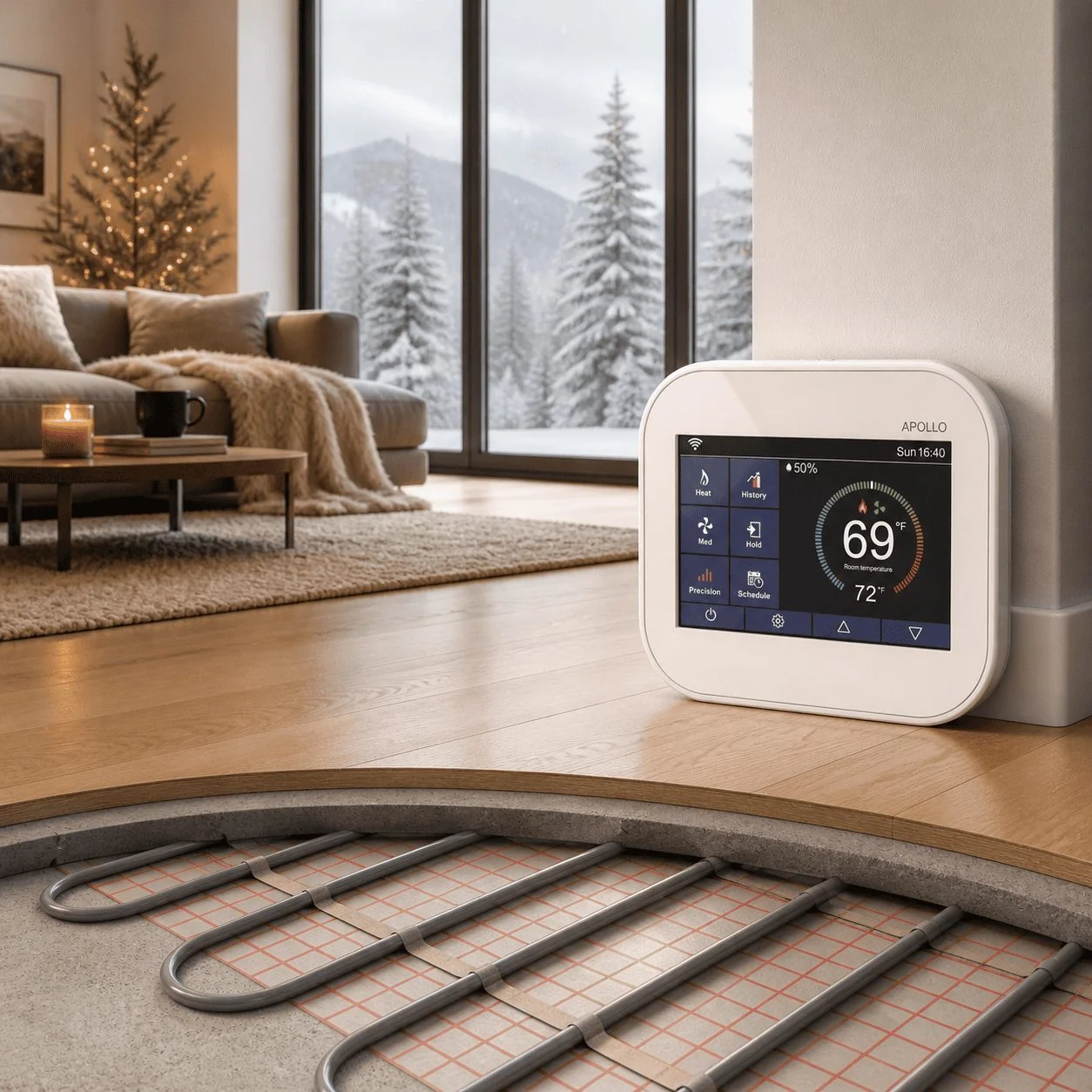
Wi-Fi radiant floor thermostat for hydronic floor heating applications, combining floor-sensor support, touchscreen control, and remote access on the APOLLO thermostat platform.

Key Benefits

  • Radiant floor thermostat keyword focus for hydronic floor heating pages
  • Flexible power options with 12-24VAC/DC or 120-230VAC variants
  • 3.5" color touch screen with adaptive brightness and intuitive control
  • Wi-Fi, BACnet, and Modbus-ready connectivity for remote access and system integration
  • External floor sensor support for radiant floor, remote room, and outdoor sensing
  • Humidity sensing and freeze protection for better environmental awareness and system safety

Specifications

  • Application: Radiant floor thermostat for hydronic floor heating
  • Power Options: 12-24VAC/DC or 120-230VAC
  • System Control: 1 stage heat / 1 stage cool for motorized valve, heat pump, and oil, gas, or electric systems
  • Sensor Support: External 17 ft sensor for radiant floor, remote room, or outdoor use
  • Fan Control: 3-speed fan plus optional 0-10VDC fan control
  • Protocols: Wi-Fi, BACnet MSTP/IP, Modbus TCP, and Control4 readiness
  • Scheduling: 5/2, 7-day, and 24-hour programmable operation

Replace 120V Honeywell T6570, T6069, T6169, TB6575A, TB6575B, TB6575A1000, T6575D, T6575C, T6574B

Replace 12 to 24VAC/DC Honeywell T8570, TB8575A, TB8575A1000, T8574B, T8575C, T8575D

Replace 12 to 24VAC/DC Coleman Rv Camper Mach Thermostat 7330G3351, 6636-3441, 7330F3852, 8330-3362, 9430-3372

Controls
Hydronic radiant valve, circulator, or boiler call; 1-stage heat/cool
Included sensor
20 ft floor/room/outdoor sensor
Relay / power
5A SPST-NO / 12–24VAC/DC or 110–240VAC
Connectivity
2.4GHz Wi-Fi, BACnet MSTP/IP, MQTT
GFCI / electric mat
No GFCI; not for direct electric cable or mat loads

Answers

Frequently asked questions

What is a radiant floor thermostat and how is it different from a standard thermostat?

A radiant floor thermostat controls hydronic in-floor heating rather than a furnace or air handler. Instead of a simple on/off call, it switches a motorized zone valve, circulator pump, or boiler call for 1-stage heat / 1-stage cool, timed around the slab's thermal lag. Because concrete or tile stores heat, the thermostat reads floor temperature directly through an external sensor rather than relying on room air alone — the APOLLO Wi-Fi Radiant Floor Thermostat ships with a 20 ft external sensor, accepts 12–24VAC/DC or 110–240VAC power, and adds Wi-Fi app control on top.

What's the difference between a thermostat for electric vs. hydronic radiant floor heating — and which is this one?

Hydronic radiant heat circulates hot water through PEX tubing in the slab; the thermostat switches a motorized valve, circulator pump, or boiler call. Electric radiant heat uses resistive heating cable or mats embedded in the floor; the thermostat switches that electric load directly through its relay and must carry built-in GFCI protection. The APOLLO Wi-Fi Radiant Floor Thermostat is a hydronic-only controller — it drives a 1-stage heat / 1-stage cool motorized valve and does not have GFCI protection. If you have electric heating cables or mats, you need a thermostat rated to switch the electric heating load directly through its relay — a different product from this one.

Do I need a floor sensor for a radiant floor heating thermostat?

Yes. Slab and tile have enough thermal mass that air-only sensing overshoots or undershoots the actual floor temperature, wasting energy and risking overheated flooring. The APOLLO thermostat includes an external 20 ft sensor that can be placed in the floor, at a remote room location, or outdoors, so the setpoint tracks the surface you're actually heating rather than just the surrounding air.

Can I use a Nest or Ecobee thermostat to control radiant floor heat instead?

No. Nest, Ecobee, and similar mainstream smart thermostats are built for single-stage forced-air furnaces and air conditioners — they have no floor-sensor input terminal and no logic for the slow thermal response of a heated slab, and they aren't wired to properly drive a hydronic zone valve or circulator relay. A dedicated hydronic radiant thermostat like the APOLLO, with a floor sensor input and valve-switching relay logic, is required for correct operation.

Can I control my radiant floor heating remotely with a Wi-Fi thermostat?

Yes. The APOLLO thermostat connects to a 2.4GHz network using IEEE 802.11 b/g/n with WPA/WPA2 security. The companion app lets you adjust the setpoint, view floor and room temperature, manage 7-day schedules, and set up GEO-fence automation from your phone. Wired BACnet MSTP, BACnet/IP, and MQTT are also supported for building management system integration, along with Google Home for voice-based monitoring.

Can I install a radiant floor heating thermostat myself or do I need a professional?

It depends on your comfort with electrical work. Installation involves wiring the thermostat to its 12–24VAC/DC or 110–240VAC power supply, connecting the relay to your zone valve, circulator, or boiler call, and routing the external floor sensor into the slab or subfloor. This is a reasonable DIY project for anyone comfortable with low-voltage control wiring who follows the wiring diagram in the product manual — but a licensed electrician or hydronic technician is recommended for line-voltage hookups, multi-zone systems, or where local code requires a permit.

What features should I look for in a good radiant floor heating thermostat?

Prioritize a floor sensor input rather than air-only sensing, a power supply that matches your wiring (12–24VAC/DC or 110–240VAC), a relay rated for your zone valve or circulator load (the APOLLO is rated 5A maximum, SPST-NO), Wi-Fi app control, and scheduling that accounts for the slab's slow response — geofence and adaptive recovery matter more here than on forced-air systems. For commercial or multi-zone jobs, wired BACnet MSTP, BACnet/IP, or MQTT support for building management system integration is also worth checking.

Why does a radiant floor thermostat need different settings or scheduling than a forced-air thermostat, and what else does it work with?

A concrete or tile slab has enough thermal mass that it heats and cools far more slowly than air, so the aggressive on/off cycling used by forced-air thermostats will overshoot the setpoint or waste energy short-cycling the zone valve. Radiant floor schedules work better with an earlier pre-heat ramp before occupancy rather than a sharp setpoint jump. The APOLLO Wi-Fi Radiant Floor Thermostat works with hydronic loops supplied by an air-to-water heat pump, or by an oil, gas, or electric boiler — part of the same APOLLO thermostat platform as the fan coil, boiler, aquastat, pool/spa, snow melt, and electric baseboard models.

MBTEK Google Reviews

Verified Google reviews from MBTEK customers across our heating and hydronic product lines.

Loading reviews…

Installation help and contact

Need an installer?We made it easy for you.

Listed installers are independent contractors, not MBTEK employees. They're skilled professionals familiar with our products and capable of efficient installation.

Any questions?Reach out to us.

Our team can help with product questions, sizing guidance, and next steps.